


The independent national survey, titled ‘The impact of tech neck and neck pain in Australia’ has revealed that while men are affected, women are the primary sufferers of neck pain in every age bracket, except 51-60, with women aged 31-40 the most impacted (73 per cent).
“Women consistently reported higher neck pain rates across all devices and settings (home and workplace), and were significantly more affected by chronic pain, mental health impacts, and productivity loss,” Dr Ali Young, Chair of the Australian Chiropractors Association (ACA) Women in Chiropractic committee, says.
With roughly three quarters of the Australian teacher workforce being comprised of women, the implications for the nation’s classrooms – from a student and teacher perspective – are substantial.
Dr David Cahill, Vice President of the ACA, says the increasing incidence and severity of tech neck symptoms is not surprising.
“We’re changing the way we’re living – we’re using our phones and our laptops and our computers so much these days and we didn’t evolve with these things,” Cahill tells EducationHQ.
“We evolved with our posture more upright and looking more at the horizon and looking for game and things we needed to be running away from and so on – but these days we’re bringing our focus to half a metre in front of our face and we’ve typically often got our heads forward.
“You see people on their phones and they’ve got their heads right down over their phones in their lap and that’s not a posture that is conducive to good spinal health.”
Over time this is gradually changing our posture and the way our spinal structures are feeding back to our brain, and that is leading to an overall body-wide effect, Cahill says.
“So it’s quite debilitating.”

Dr David Cahill, Vice President of the ACA, says classrooms are rightly set up for kids, but that often means a teacher’s workstation is just a laptop on a desk, and not properly set up ergonomically.
While initially beginning as pain in the neck and the muscles of the neck, the long-term implications can be quite severe in terms of work, lost productivity, less enjoyment of life if the condition develops into chronic ongoing pain.
“It’s a niggle there that kind of never leaves you and starts to impact upon you, and probably most of us have experienced it at some point and we’ve experienced ourselves being perhaps a bit short with those around us, and not being the person we want to be if we’re dealing with something like that,” Cahill says.
The survey found that women using laptops were 23 per cent more likely than men to sit at non-ergonomic desks at work, which was associated with a 16 per cent higher incidence of neck pain than in women who used an ergonomic workspace.
Additionally, women were 31 per cent more likely to slouch while using laptops than men, with 86 per cent of female ‘slouchers’ experiencing neck pain compared to 75 per cent of slouching men.
In terms of ergonomics, Cahill says he’s not sure teachers get the support that they should and workstations in many classrooms are probably something of an afterthought.
“Classrooms are set up for kids, which they need to be, but a teacher’s workstation is probably often just a laptop on a desk, and so when the teacher is working on their device, it’s not properly set up ergonomically, so they’re suffering there and so the predominance of women in work situations where perhaps ergonomics aren’t paying enough attention to is an issue.”
So what can teachers and students do in response?
“I would encourage teachers to go to spinalhealthweek.org.au where there’s a lot of resources - fact sheets, a postural guide, there’s an ergonomic checklist, there’s a device checklist for using devices safely.
“They’re simple things but if you take them as a whole they can make a big impact.
“It’s all free because we see this is as such a problem, but with some minor behavioural change so much benefit can be had.”
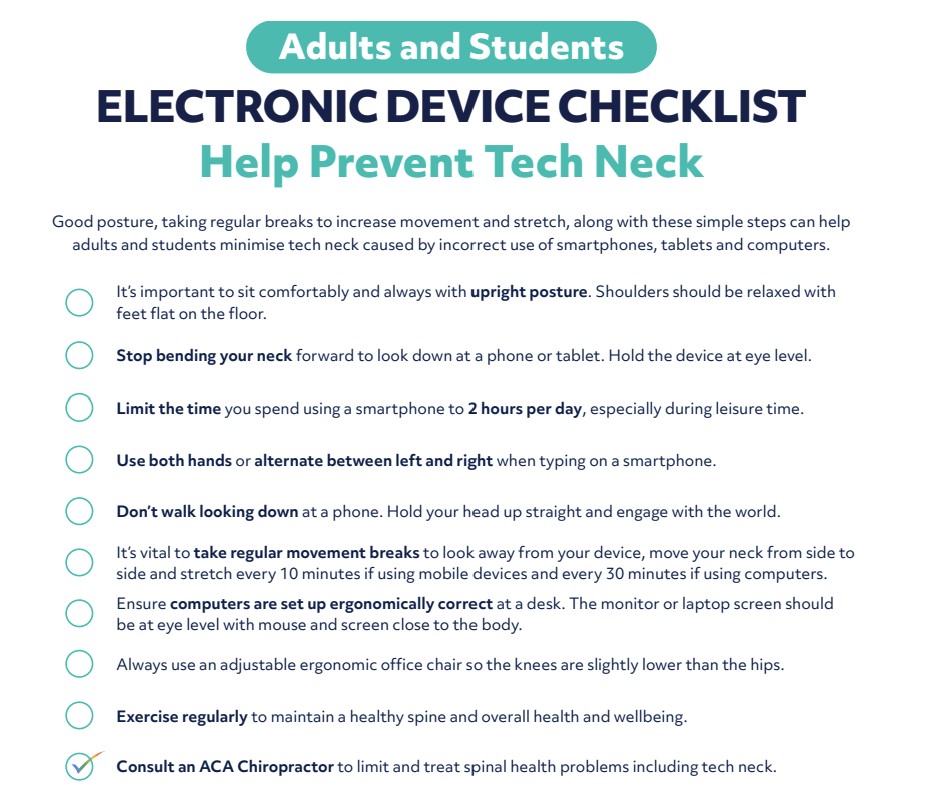
Source: Australian Chiropractors Association
Young says with technology an essential part of our everyday lives, not only must we monitor the length of time we use our devices, but we must be cognisant that overuse and the way we use them can negatively impact our spinal health as well as our mental health.
“With only 36 per cent of neck pain sufferers being aware that their neck pain was linked to device use, to help prevent users developing tech neck it’s imperative we adjust our thinking on how we use technology, how often we use it and the way we use it,” Young says.
For students, it can be as simple as short, sharp regular routines.
In the classroom you typically see some kids who fatigue very quickly when they try to sit upright. They’re the ones that slouch and their back goes into a c-shape very quickly; they can’t hold that upright position, whereas if your spine is working well, it’s natural to sit in quite an upright position.”
Cahill explains that it’s really encouraging children and teens to walk tall, stand tall, sit tall, to be aware of their posture.
Good spinal health is something that we learn as we grow, he says.
“For posture at school, it might be a case of ‘righty-o, let’s all stand up tall, let’s stretch our arms out on top of our heads and have a stretch for 10 seconds'.
“If that becomes part of the day that’s going to be good for the teacher as well as for the students.”
In a separate survey of ACA Chiropractors, Young says a worrying trend observed since COVID is that the cases of children and teens experiencing neck pain has surged making them vulnerable to spinal health issues and additional health implications now and in the future.
“ACA Chiropractors reported a sharp rise in tech neck among young people with 34 per cent reporting a ‘significant increase (+25 per vcent)’ and 27 per cent a ‘moderate increase (11-24 per ent)’ in teens. 29 per cent reported a ‘significant increase,’ and 25 per cent found a ‘moderate increase’ in children experiencing tech neck so it’s vital we educate kids early on healthy device habits to help prevent long-term neck-related health issues,” she shares.
While medications may offer temporary relief from neck pain, academic studies, including research from the University of Sydney, show opioids do not benefit people with acute neck or back pain (lasting up to 12 weeks) and have no positive role in treatment; comparatively, studies have shown that commencing treatment for tech neck promptly is crucial in preventing further functional decline and progression to a chronic condition.
With MSDs, including tech neck, costing the Australian economy more than $55 billion annually through direct health costs, lost productivity and reduced quality of life, the burden on Australians and our economy is significant.
If schools can be doing their bit to encourage good posture and avoiding tech neck, the benefits are clear.