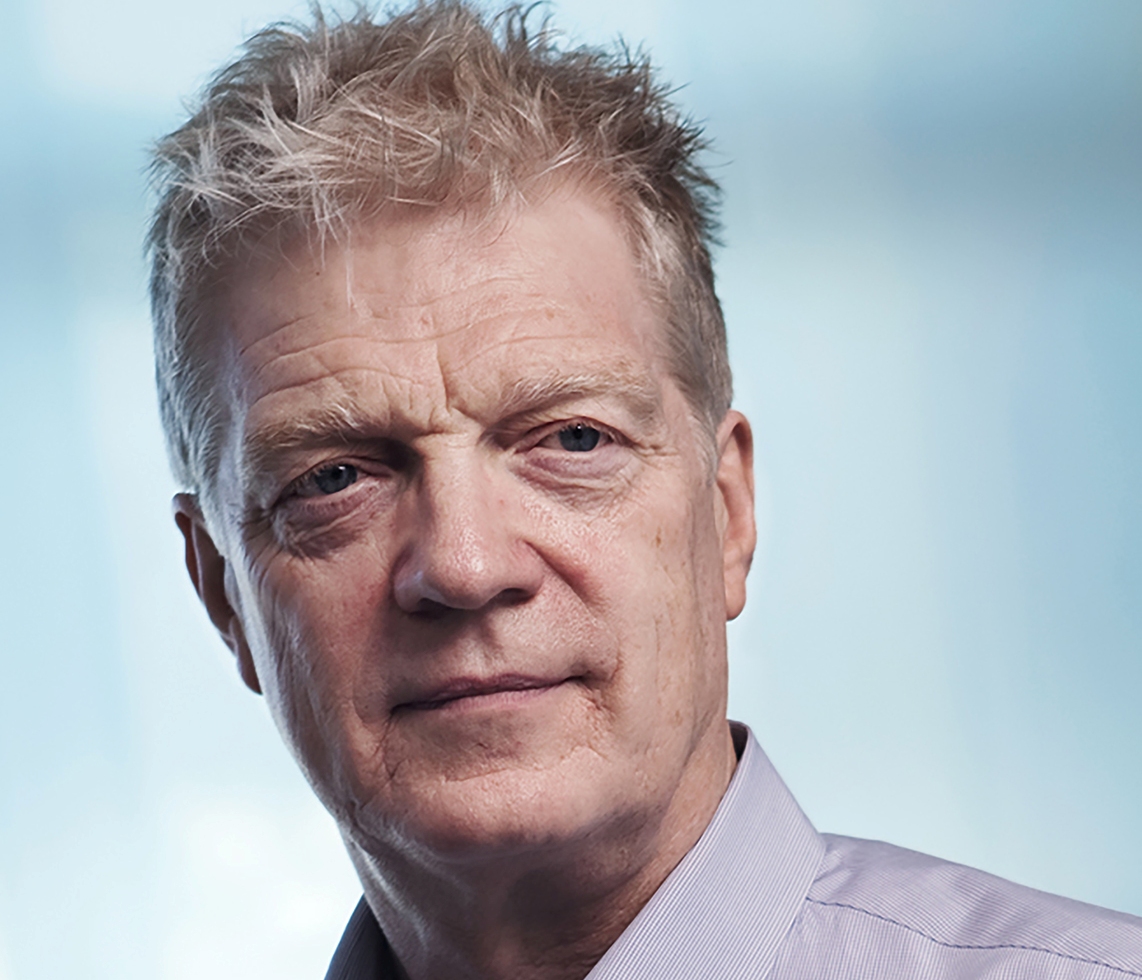
Someone who has worked at the educational coalface and yet has the ability to get their head above the water and see the madness of formal schooling for what it really is. Someone who is equally amusing and articulate with the spoken word and eloquent and intellectually rigorous with the written word.
Someone with a wonderful sense of humanity and the capacity to deliver strong and powerful messages. Someone who advocates for creativity and the arts as absolutely essential components to a full and rich education, when so many others are shouting louder about the primacy of literacy and numeracy and a 'back to basics' approach.
Someone captivated by the individual and the need to truly personalise education rather than the one-size-fits-all approach which, possibly despite our protestations, is still the absolute norm in schools. Someone who recognises that to truly engage a student, we have to know what makes them tick and help them to discover their own unique talents.
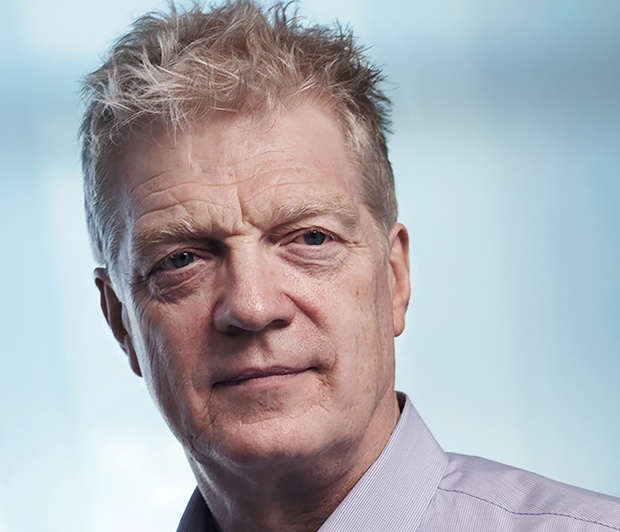
It will come as no surprise that Sir Ken Robinson was that person. Born with polio in working class Liverpool in 1950, Robinson’s stellar trajectory was unlikely. No-one would have predicted that he would be knighted for his services to the arts and be an international best-selling author and have the most viewed educational broadcast of all time. What an incredible gift it has been for educators in the 21st century to have had him as a role model and as an educational compass.
One of Robinson’s greatest capacities was his sense of humour and his ability as a storyteller. As he would say, when he was in front of an audience, he was in his element. He had a very particular way of enthralling an audience with personal anecdotes, always drawing us in with warmth and wit before hitting us with the killer punch of his message.
I remember watching his extraordinarily popular TED talk from 2006 titled Do Schools Kill Creativity? and being fascinated that, of the 19-minute talk, he spends about 15 minutes essentially off-task! I mean at one stage he describes himself cooking an egg! It is the build up, the drawing in of the audience, the connection with our humanity that allows him to share the power of his message.
One of the aspects of that talk which I remember most vividly is his story of the little girl who was sent to see a specialist because she was distracted and distracting in class and her teachers thought she had a learning disorder. As he says, these days she would have been diagnosed and medicated for ADHD.
In Robinson’s words though, there was nothing wrong with her, it’s just that ‘she needed to move to think’. She went on to become a celebrated soloist with the Royal London Ballet and the choreographer for Cats and Phantom of the Opera as well as many other accolades during a long and illustrious career.
Robinson draws our attention to the absolute need for educators to look beyond the obvious and to use our own creativity to explore what our students really need. How many of our students possibly need to move to think? And how are we catering for them?
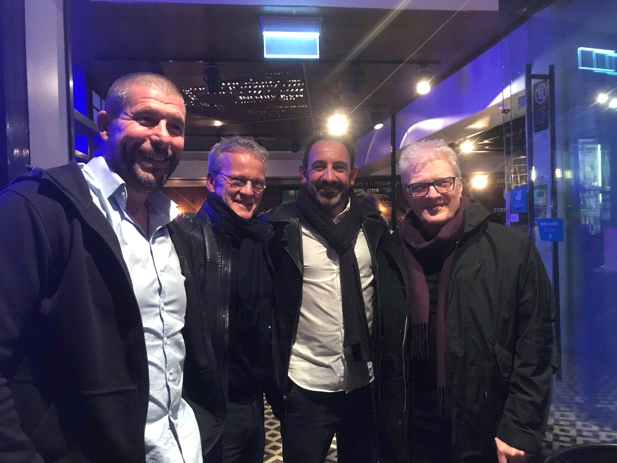
Dan Haesler, Pasi Sahlberg, Tim Perkins and Sir Ken Robinson.
My brilliant colleague Dan Haesler provided me with the highlight of my professional career by inviting me to dinner with Sir Ken and Pasi Sahlberg in Sydney last year when we were all speaking at EduTECH. Sharing a meal with Sir Ken Robinson was a hilarious affair. He was like the funniest, naughtiest school kid who is able to take the mickey out of everyone and everything without ever offending anyone.
The magnetic force of his personal orbit was utterly compelling. He was so dry and was always on the lookout to make people laugh. Despite being nearly 70 years old, he was deeply in touch with his inner child. He had a playfulness and lack of seriousness that belied his age, his status and his influence. He was truly a breath of fresh air.
At one stage during dinner he asked me what I was reading. I told him that I was reading a fascinating book called At The Wolf’s Table about Hitler’s food tasters. We were sharing entrees and he twisted my words and then accused me, much to everyone else’s vast amusement, of comparing him to Hitler as he had offered me some of the entrée before trying it himself. He feigned deep offense and questioned whether this was how I treated all international guests! We were all in hysterics and it was literally one of those side-splitting comedy routines where you are almost begging for it to stop because you need to breathe again!
There was more of the same the following morning when I had the great pleasure of an impromptu three-hour breakfast with Sir Ken and Australian visionary educator and founder of the Living School in Lismore, John Stewart. After hours of great conversation and many more laughs, Sir Ken turned on me and said, ‘Is your wife more attractive than you are?’ Somewhat surprised by the question, delivered as if it was apropos of nothing, I said yes indeed she was and he said, ‘Well why am I sitting here with you again and not her?’
He asked me to call her on FaceTime so he could discuss the matter with her! He took my phone and when my wife - who is an art teacher and a big fan of Sir Ken’s as well - answered she could not believe who was calling! He invited her to come and take my place, but she explained that she was at school and just about to go to class.
Needless to say, her colleagues in the staffroom were gobsmacked! Who the hell gets to FaceTime Sir Ken Robinson! He set up the whole skit for his own as well as our entertainment. He brought joy. And like the little girl in his story, I have very little doubt that he also would have been medicated for ADHD. Fortunately for him, as he comically states in the telling of her story, ‘it wasn’t an available condition’ at the time.
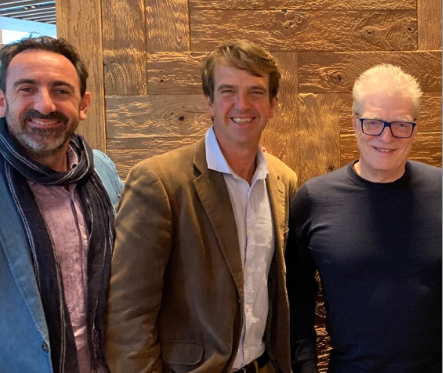
Tim Perkins, John Stewart and Sir Ken Robinson in Sydney, 2018.
Robinson was highly regarded in high places as well. He was a central figure in developing a strategy for creative and economic development as part of the Peace Process in Northern Ireland, working with the ministers for training, education enterprise and culture. He was very proud of being able to play a role in breaking down the sectarian troubles in Ireland through the medium of the arts.
Despite his incredible breadth of intellect and his vastly entertaining sense of humour, it was his contributions to the pantheon of challenges to the many antiquated approaches we have to education that are his real legacy.
As a highly educated man who worked for more than 10 years as a Professor of Education at Warwick University in the UK, Robinson stressed that creativity and the arts in particular, were absolutely foundational and instrumental in developing an awareness of ourselves, our skills and our relationships with each other and the world so as to become fulfilled individuals and active compassionate citizens.
Robinson was passionate about the capabilities of children and what it is to be a good teacher, stating that "a properly conceived education is a conversation. It’s a dynamic encounter that is guided by expert and knowledgeable mentors".
How many teachers have the confidence, grace, humility and capacity to recognise that sort of approach to education?
Robinson spent the last 20 years of his professional career calling for us to consider a significant education revolution. He said that we need to bring ourselves out of an "educational death valley".
“The fact is that given the challenges we face, education doesn’t need to be reformed - it needs to be transformed. The key to this transformation is not to standardise education, but to personalise it, to build achievement on discovering the individual talents of each child, to put students in an environment where they want to learn and where they can naturally discover their true passions.”
Robinson’s strongly held view has always been that it is pointless trying to tinker around the edges of a system that is no longer working or fit for purpose, and that instead we need to reconceptualise education all together. Despite his seemingly avuncular demeanour, Sir Ken Robinson was tough. He didn’t mince his words when it came to his beliefs and concerns about our education systems.
His view was that our schooling system is "stifling the individual talents and abilities of too many students and killing their motivation to learn." He felt that our role is to cultivate student motivation by nurturing an environment of respectful awareness of our students’ natural skills and interests. As he stated, "when students are motivated to learn, they naturally acquire the skills they need to get the work done. Their mastery of them grows as their creative ambitions expand".
Robinson encourages us as educators to challenge the three C’s that are really suffocating and holding our students back from flourishing, these being 'conformity', 'compliance' and 'competition'.
Conformity with what we value is making too many children feel that they ‘don’t fit’; compliance with a system which is clearly no longer fit for purpose is damaging both our students and us as a profession - and finally the elevation of competition and individual success over collaboration is distancing us from each other, reducing trust and denying us the opportunity to develop the community we need to address the challenges and opportunities of the future.
Sir Ken Robinson has spent his professional life researching, arguing for and legitimising the need for us to rethink the purpose of education and how we do school. Let us all honour his legacy by doing our bit to stop lamely perpetuating the status quo (an environment in which neither us nor our students are happy or thriving) and create the schools where we really want to teach and our students really thrive through wanting to learn.
Sir Ken’s thinking was focussed on education but it was really about improving humanity. As Pasi Sahlberg said after hearing about his friend Sir Ken’s death: “We will carry on his legacy for a better world. We will we must.”
Vale Sir Ken Robinson, a wonderful intellect and advocate for educational transformation and a very funny bastard as well!