


More than three-quarters (78.2 per cent) of Australian schools are harnessing AI tools, according to findings from Campion Education, whose Digital Landscapes in Australian Schools 2025 Report discovered 20.6 per cent of schools are intending to either introduce or raise their use of AI tools for teachers and/or students.
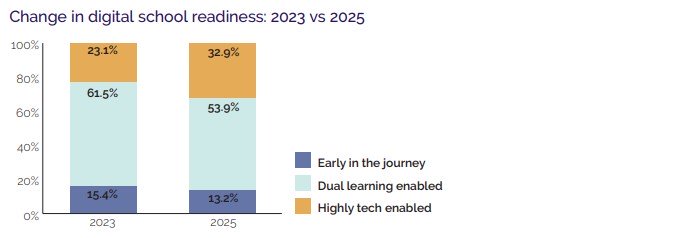
While AI usage is expected to ramp up, many are prioritising a 'balance' between online and print-based teaching approaches, with 53.9 per cent of those surveyed describing their school as set up for dual learning, combining digital and print resources.
This dual approach, particularly in primary education, is seeing schools utilise tools that combine online and traditional learning to support early development.
“Technology has undeniably transformed classrooms in Australia, especially for K-6 students learning in an AI-enhanced environment,” Logitech ANZ managing director Damian Lepore says.
“... the modern classroom isn’t about choosing between the screen and the page – it’s about empowering a new generation of learners with the right tools for every task.”
Lepore says through durable, intuitive technology, teachers can immerse primary students in the digital world while simultaneously blending tactile experiences.
“Whether it be drawing with a stylus or reading a physical book, both aspects are critical to children’s educational journey,” he says.
Source: Digital Landscapes in Australian Schools 2025 Report
Since the first Digital Landscapes in Australian Schools Report in 2023, it is clear schools have continued to adapt, innovate and, in many cases, lead when it comes to embedding technology into learning and administration.
Respondents in the survey this year said they were particularly concerned with data security; and the most significant consideration when schools were choosing a new technology partner is their data management and privacy policies.
The report found that 32.9 per cent of respondents identified their school as highly technology-enabled, exhibiting strong use of digital tools and resources – up from 23.1 per cent in 2023.
Management, connectivity and learning management systems (LMS), such as Compass and Canvas, were highlighted as the most popular digital technologies used within schools.
This was followed by PDF textbooks, learning software, AI for education, interactive textbooks, and education games and esports.
A number of respondents expressed concerns about the ability of staff to learn, or be willing to learn, how to implement the technology successfully in the classroom environment.
Respondents expressed the need for teachers to have access to both the technology, and the training to use it effectively.
The three digital technologies that schools want to use more of, but are experiencing barriers to implementing, are Virtual and Augmented Reality for education (20.8 per cent); followed by AI for education, and PDF textbooks.
Government schools are advancing on their technology journey, the survey found, however they still trail non-government schools.
While the number of non-government schools identifying as dual learning or high-tech enabled has held steady at around 75 per cent, government schools are making noticeable strides – with a rise from 64.3 per cent in 2023 to 69.1 per cent this year.
Source: Digital Landscapes in Australian Schools 2025 Report
Still, more government schools (11.9 per cent) identify as being at the start of their digital journey compared to non-government schools (10.2 per cent).
In dual learning environments, non-government schools continue to lead (47.5 per cent vs 42.9 per cent), though government schools, the report said, are steadily catching up.
Commenting within the report, edtech expert and author Leon Furze said careful consideration of how student data is collected and used is required, particularly with regards to AI.
“Schools should be able to implement personalised learning approaches while maintaining strong privacy protections,” Furze said.
“This might mean choosing tools that process data locally or that don’t require student personal information.
“The focus should be on finding solutions that enhance learning while protecting student privacy as a fundamental right.”
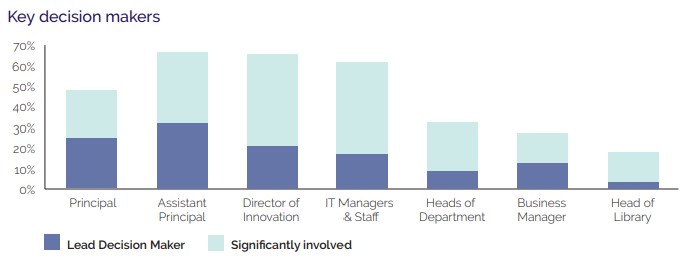
Not surprisingly, the survey revealed that senior leaders play the most significant role in determining the school’s digital technology strategy.
The Assistant Principal for Teaching and Learning / Curriculum was identified as the lead decision-maker in the school’s digital technology strategy (31.5 per cent), followed by the school’s principal who was listed as the lead decision maker in 24.4 per cent of responses.

A number of survey respondents expressed concerns about the ability of staff to learn, or be willing to learn, how to implement technology successfully in the classroom environment.
As edtech continues to evolve, additional training and resources to support teachers in adapting to new digital tools will be critical to ensure successful implementation.
“Prioritising consistent training opportunities for teachers and support staff is vital for schools to instil confidence among parents and pupils alike,” Lepore says.
“When harnessed effectively, it’s clear that the combined potential of print and digital learning tools is far greater.”
The report’s release coincides with the announcement today that more than 30,000 teachers could be trained in the use of AI technology as part of a year-long trial spearheaded by US tech giant Microsoft and Australia’s Future Skills Organisation.
The firms launched the pilot program today in Canberra in collaboration with 13 industry and education partners, in a move designed to promote wider adoption of AI technology.
The plan to boost Australia’s AI use comes a day after the Productivity Commission recommended schools deploy the technology for both teachers and students, and after it named AI adoption as one of its priorities for the year.
Artificial intelligence technology is also expected to be a major focus at the Federal Government’s Economic Reform Roundtable next week.
To read the full ‘Digital Landscapes in Australian Schools 2025 Report’, click here.