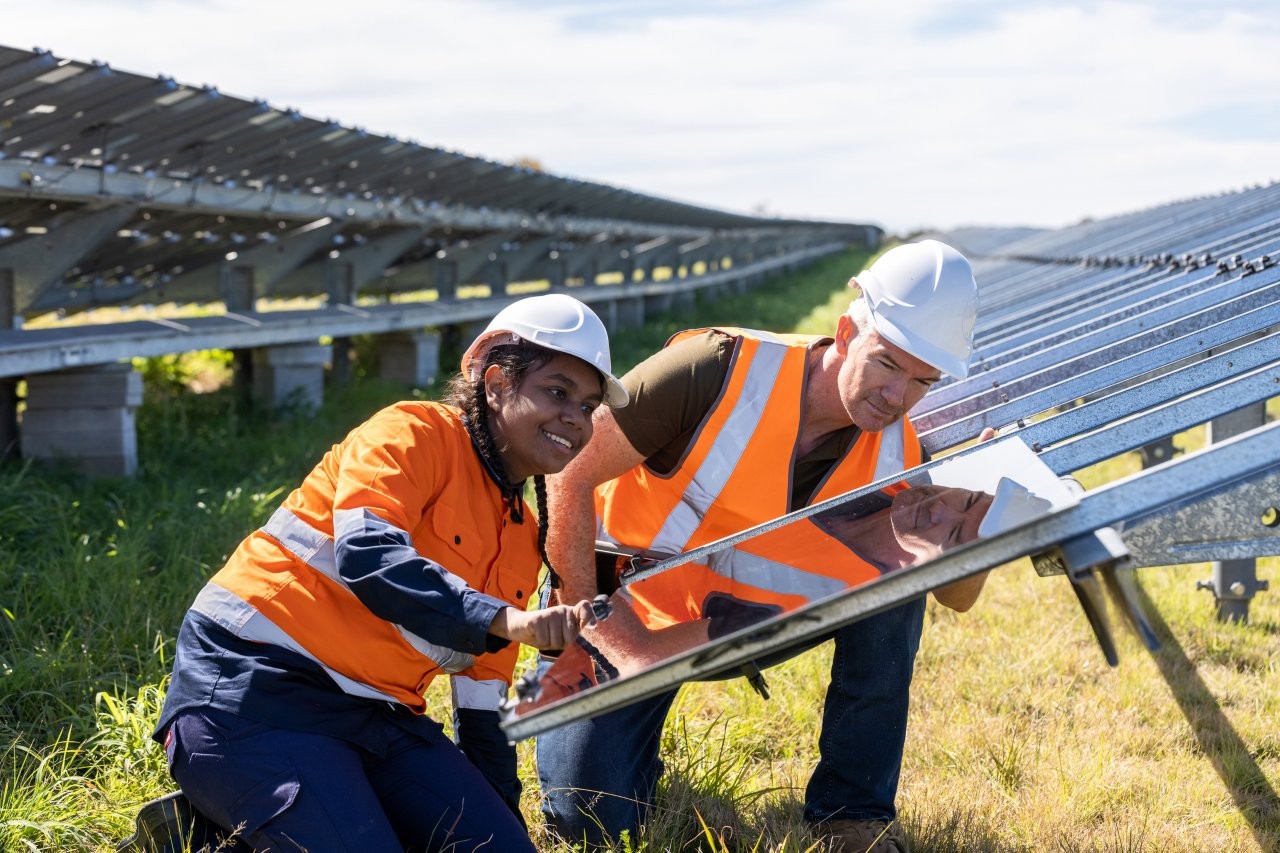
As a nation we’re at risk of a critical skills shortfall in the clean energy transition, with demand for workers set to outstrip supply by tens of thousands within a decade.
But introducing high school-age students to renewable energy is a tricky task. How many of them even know it’s a career option? And how do we know if they have an interest in or aptitude for this area if the subjects aren’t taught in their school?
It’s this challenge that a new pilot program called Net Z(ed) is tackling head-on.
Led by Duncan Burck, CEO and founder of MCB Business Partners, Net Z(ed) is giving high school students in New South Wales direct exposure to energy careers, connecting them with industry professionals, and providing hands-on projects and pathways into trades and technical roles.
“We’re showing students that energy is not just a job of the future – it’s here now, and it’s full of opportunities,” Burck says.
The program aims to bring the Net Zero and decarbonisation story to life in school classrooms.
“Net Z(ed) education is really about opportunity awareness, and helping teachers tell that story and giving the kids the opportunity to have that experience, but making sure we’re not influencing syllabuses or curriculum, just really helping the teachers get this story out,” Burck tells EducationHQ.
Some time ago, MCB developed a software platform that allowed the organisation to look at how it could capture data and insights from learning experiences and then create a metric that would show value for industry and government to warrant their investment in things like industry education-sponsored programs.
Having previously used methodologies and processes to produce school programs related to cyber security, maritime marine and the space industry, MCB was approached by the Federal Government to consider a project related to net zero.
“The Government said ‘we want to be at the front of the line for this. Can we do something?’ And they wanted us to deliver, firstly, a brand that people can connect with (Net Z(ed), and secondly, can you get disparate groups of industry, academia, universities, departments of education to actually want to collaborate on this work?
“And the third piece was, can you start developing short lessons or lesson sequences that a teacher would actually be able use in the classroom?”
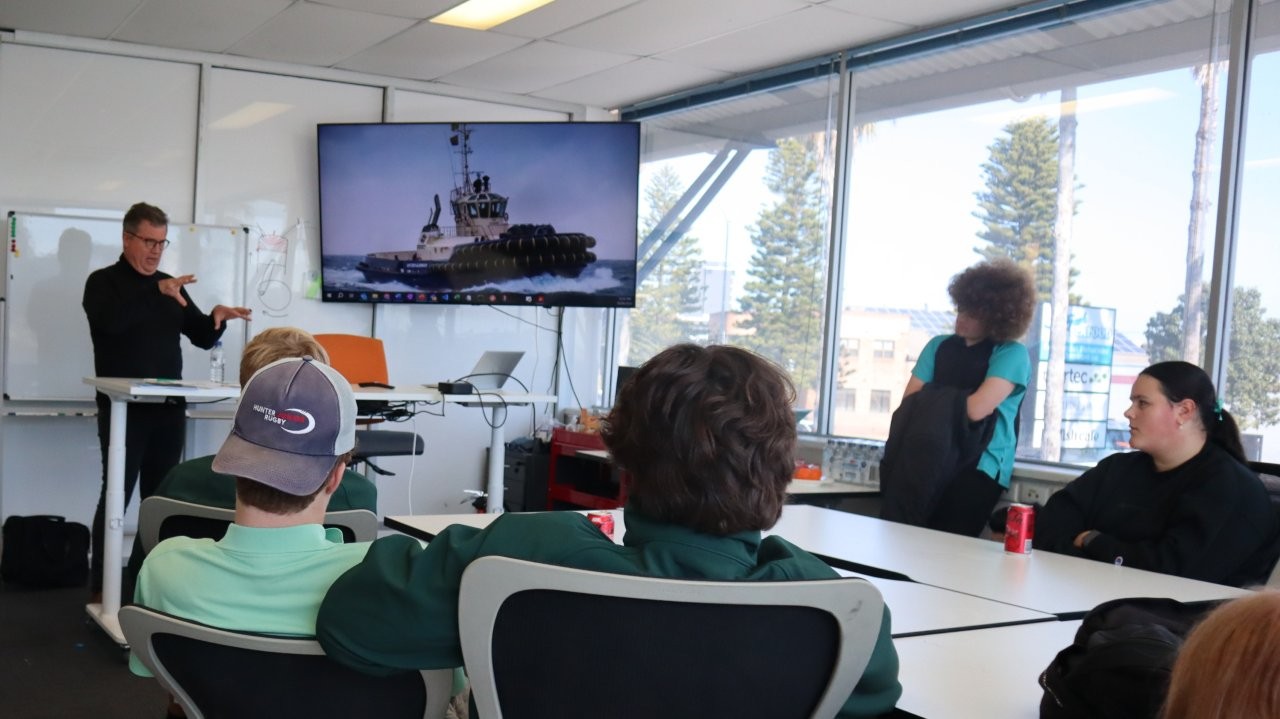
“There’s so many wonderful things that are happening in the evolution of our economy,” Duncan Burck, pictured far left, says. “How do we make sure that [students] have all of the things on the table in front of them?”
Working closely with the NSW Department of Education, Trailblazer for Recycling and Clean Energy (TRACE), and selected industry partners, the Net Z(ed) pilot is currently engaging Year 7-10 students across NSW.
Key aspects of the program, as requested, include creating short, easily deployable lesson plans for the secondary school curriculum.
The first lesson, focused on designing photovoltaic systems and easily integrated into Geography, Science, and Mathematics classes, was curated by Professor Paul Dastoor, co-founder of Kardinia Energy, and the person who first printed solar, which is now powering Coldplay concerts around the world.
“The first class was around understanding the difference between power and energy, and then actually designing a solar system to capture a certain amount of energy to actually generate the power required for that particular piece,” Burck explains.
“But as part of that process, it was delivered in a way where it could land in Physics, and in the stage five lesson, it could also potentially land in a commerce class, because it was looking at the actual economics of solar generation as well.”
The next phase of the project involves TRACE activating digital credentials for 300 students. TRACE is at the forefront of research going on around energy and the ways to decarbonise our economy.
“One of the big obstacles that we came across in the pilot, which wasn’t surprising, was teachers being confident to deliver this type of content because net zero decarbonization is still quite a new topic,” Burck explains.
“The next phase then, is to go out and help teachers build confidence ... introduce them to a learning sequence, and be there to actually support them in delivering it for the first time, along with a career discussion.
“We’ll be going into probably 50 schools over the next two terms with this lesson that’s been designed as part of net zero education, or Net Zero Education 1.0, now going to 2.0.”
Burck says importantly, rather than simply being STEM related, the decarbonisation of our economy touches numerous areas of the syllabi.
“It really appeals to the arts and the creatives and a whole different group of students that might not even think that they have a role to play.
“Why are people very concerned about offshore wind farms or how do we have the discussion around decarbonisation in a community that is reliant on mining?” he poses.
“There’s so many different components of this whole net zero decarbonisation journey.

“… we can't be expecting our teachers to be bringing the energy story to life alone. Industry and government need to be involved in that process, because teachers have a lot on,” Burck says.
There’s a lot of skills and it’s not just building electrical power plants, Burck explains.
“The assessment and the analysis that we’ve done of where the jobs are going to be, yeah, there’s a lot of electric technology stuff, but it’s the change. It’s the soft management. It’s the helping businesses be more sustainable. It’s understanding digital analytics. It’s project management. It’s stakeholder engagement.
“That’s where all the opportunity is going to come in. And net zero education is going to be covering all of those.”
Burck says he’s now developing the strategy and business case for Net Z(ed) to be modelled and activated in local regions, which will allow industries there to actively support their schools in increasing awareness of Net Zero and all its opportunities for young people in their area.
“If we can help create a jigsaw puzzle picture of where a young person might see themselves, getting to that point of putting their jigsaw puzzle together, picking the right courses, doing the right things, the extracurricular pieces or whatever, if we can show them much earlier what their future could look like based on what you’re interested in, then it’s much easier to make those decisions and deciding where to put those puzzle pieces to start in towards that journey.”
National energy trades workforce snapshot
- In NSW, the workforce has grown marginally over the past 15 years, from 78,000 workers in 2010 to about 82,000 in 2024. Apprentice numbers (currently about 16,000) are well below the 2030 target of 23,000.
- The ACT’s workforce has grown slightly over the past 15 years, from 2900 workers in 2010 to about 3000 in 2024, despite a tenfold increase in the territory’s energy project pipeline over the past five years. Persistent shortages exist across most key trades, with job listings at record highs.
- The Northern Territory’s energy trades workforce has remained static for 15 years, with about 2800 workers recorded in 2010 and 2024, despite a tripling in the project pipeline to $38 million in 2024 (from $12 million in 2015). Persistent shortages affect most key trades.
- Queensland’s energy trades workforce has grown 24 per cent from 52,500 workers in 2010 to about 65,000 in 2024, but this growth has not kept pace with a more than tenfold rise in the state’s energy project pipeline over the past decade (from half a billion dollars in 2015 to $7 billion in 2024).
- South Australia’s energy trades workforce has grown from 16,500 workers in 2010 to about 20,000 in 2024. However, this 21 per cent increase has not kept pace with a more than six-fold rise in the state’s energy project pipeline over the past five years (from $100 million to $600 million). Severe shortages affect most key trades, with job listings at record highs.
- Tasmania’s energy trades workforce has grown from about 5100 workers in 2010 to approximately 6100 in 2024, but despite this 20 per cent increase, worker shortages persist across most key energy trades.
- Victoria’s energy trades workforce has grown strongly over the past 15 years, from about 46,000 workers in 2010 to almost 77,000 in 2024 – a 65 per cent increase. However, severe shortages persist across most key energy trades.
- In Western Australia, the energy trades workforce has grown sharply over the past 15 years, from 16,500 workers in 2010 to about 42,000 in 2024. Despite this 40 per cent increase, severe shortages persist across all key energy trades.
To learn more about Net Z(ed), click here.