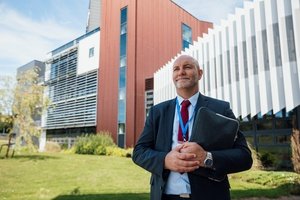


Shaun Brien leads inclusive learning at a Melbourne secondary school and says the Department has been encouraging teachers to undergo training in Universal Design for Learning (UDL) – a popular framework that aims to give all students a personalised learning pathway by providing multiple means of access and participation to the same content within the one lesson.
There’s a glaring problem with this approach, Brien warns.
“Universal Design for Learning sounds incredible, because it sounds like you're doing the best for every learner in the classroom – but it has a really questionable evidence base [and it] prioritises student preferences over functional needs,” he says.
Following UDL, Brien says he has seen schools mandate that some students use their device to type and communicate in class, despite there being no specialist recommendations for this to happen.
These students are capable of writing by hand but prefer not to, most often because they find it challenging – and in such cases a device mandate is essentially a ‘bandaid to cover a bullet wound’, Brien says.
Despite numerous meta-analyses pointing to UDL’s positive impact on learning, upon closer scrutiny the results almost always centre on student engagement surveys and/or children’s own reported enjoyment in class and not actual academic progress, the expert adds.
This is a self-fulfilling prophecy, according to Brien.
“If you provide students with their preferences, of course they're going to give you positive data about the strategies that you're rolling out because they're not going to be thinking about how much (has been) learned or not learned…”
Another ‘lethal mutation’ to spring from UDL is the need to offer students ‘multiple means of representation’ in a bid to ensure full inclusion, Brien argues.
He says this runs contrary to the explicit teaching model underpinning the Department’s new instructional push.
This incoherence is really challenging for the state’s schools, he suggests.
“There's been some great stuff (happening) at the moment, especially in the last couple of years with the rollout of the VTLM 2.0 with explicit teaching.
“I think often in schools, inclusion, instruction, pedagogy and teaching practice often get separated when they're one and the same.
“So [it’s] been a really positive step [that’s] showing that really solid Tier 1 instruction, if you're following a multi-tiered systems of support (model), is the most inclusive thing that you possibly do in the classroom.
“And then your Tier 2 interventions should be able to catch most of your students, and then any Tier 3 interventions are for those specific functional needs, (following) recommended adjustments by specialists for those students with additional needs.”

Learning specialist Shaun Brien says by trying to cater to all preferences in the classroom, UDL dilutes the overall quality of a lesson.
The tenants of UDL don’t align with this at all, Brien says.
“I remember being in a professional learning for UDL, where it referred to teaching as something like a buffet rather than a set menu where everyone's able to choose what they want.
“It immediately stuck out to me because all I could think was, ‘you rarely go to a buffet because everything's really high quality’ – you go because you can have a little bit of everything, but you're accepting that the quality is a little bit worse overall.
“Whereas [with] a set menu you're expecting really high quality the whole way through.”
This thinking applies to the classroom in the same way, Brien says.
“We shouldn't be diluting the quality to give an individual pathway to 25 or 30 different learners, when we know the evidence supports that explicit teaching should be able to have success for around 80 per cent of the classroom the majority of the time…”
For the remainder, teachers’ checks for understanding and targeted instruction will catch up around 95-98 per cent of the class before small group intervention comes in, Brien adds.
The idea that every student should be able to engage with learning in the medium they feel most comfortable presents something of a nightmarish burden for staff planning and workload, the expert adds, as well as for meaningful formative assessment during class.
Educators are already under the pump here, he cautions.
“One of the biggest challenges is that inclusion already adds such a significant workload to teachers and staff, for each student that we have to go through this funding process for, you're looking at 10 to 20 hours of work per student.
“…I know schools where there's up to 400 students that they need to go through this process for, and they might only have one or two leaders in the space to go through all of that, and to then have staff be able to meaningfully make those adjustments is challenging…”
Explicit instruction done well is the most effective inclusion leaver schools have, Brien says.
“This isn't just coming from my opinions, it's coming from a strong evidence base that spans way back to the 1980s, where [researchers] found that the elements of explicit teaching work best for students with learning disabilities.”
Recommendations from specialists also align with the elements of explicit teaching, he notes.
“We constantly get told from specialists that these students need consistent routines, that you need to minimise transitions, you need to break down content into small steps, you need to model and think aloud about how to use the new knowledge, you need to frequently check for understanding, you need to slowly fade scaffolds over time, you need spaced retrieval practice and interleaved learning.
“If you look at all these recommendations, you're like, ‘if we just implement explicit teaching we are not only meeting the needs of this student, we are meeting the needs of all students', and therefore there's less of a burden on staff …
“It means they don't have to create something brand new from scratch every lesson for the student because the solid core instruction should be able to meet them at their point of need.”
Brien has prevously argued that many frameworks and tech products within inclusive education are very appealing but have questionable impact on outcomes for students with additional needs.