


Speaking at a recent Independent Tertiary Education Council Australia (ITECA) parliamentary forum, new Coalition education spokesman Julian Leeser called for the inquiry, outlining his worry that boys are being “left behind by our education system”.
“I am concerned about trends and outcomes we have been seeing in relation to education for boys,” he said.
“Boys trail girls in every NAPLAN literacy assessment – reading, writing, spelling, grammar and punctuation – in every age group.
“Average achievement of boys falls short of girls in every NAPLAN domain except numeracy.
“By Year 9, in writing, there is a 37-point gap between the performance of boys and girls – which roughly equates to 1-2 years of learning,” Leeser noted.
The problem has also drawn the attention of Catholic Schools NSW’s research unit, which earlier this year published a damning report calling for greater policy attention to address the dire situation facing boys’ schooling.
“As one researcher put it, the persistent underperformance of boys in our school system is the social justice issue that nobody is talking about,” the report states.
It has been over two decades since the last parliamentary review into boys’ education in 2002, with ‘ideological quarrels’ hampering efforts to implement recommendations to any great effect, the report suggests.
The same alarming trends for boys are still underway in 2025, researchers add.
“The four trends that formed the catalyst for the original inquiry – namely, gender gaps in primary-level literacy benchmarks, secondary-level tertiary entrance scores, retention rates, and higher education participation – are all as salient now as they were 20 years ago.”
Despite the scale of the problem, boys’ academic underperformance has been neglected by policymakers, with the focus given to areas where girls lag such as in STEM and maths – this has been to the detriment of boys, they contend.
They note while there are scholarships to boost girls’ participation in maths, there are no incentives to lift boys’ aspirations and interest in the humanities.
“While it is important to address gender gaps that disadvantage girls, such as in mathematics and certain STEM subjects, these do not preclude complementary efforts to close other gender gaps that negatively affect boys.”
The gender gap in achievement is most strongly illustrated in NAPLAN results, researchers flag.
Indeed since NAPLAN testing began in 2008, a greater percentage of boys than girls have failed to meet the national minimum standard across year levels tested in four out of the five testing domains.
Girls achieve higher average scores than boys in all 16 literacy assessments, but boys achieve higher average scores than girls in all numeracy assessments.
But there’s a catch here: the gaps are not equal.
“Notably, by the time students reach Year 9, the ‘numeracy gap’ (in favour of boys) is usually smaller than the ‘literacy gap’ (in favour of girls).”
In literacy assessments, boys are over-represented in the lowest achievement bands and are twice as likely as girls to be in need of additional support.
The literacy gender gap also widens with time, research by the University of Queensland’s Dr Damon Thomas has found, with a significant drop off during boys’ transition to secondary school.
“Female literacy performance does not appear to be affected in the transition from primary to secondary school, while many more males struggle to meet the increased literacy demands of the secondary years,” his study found.
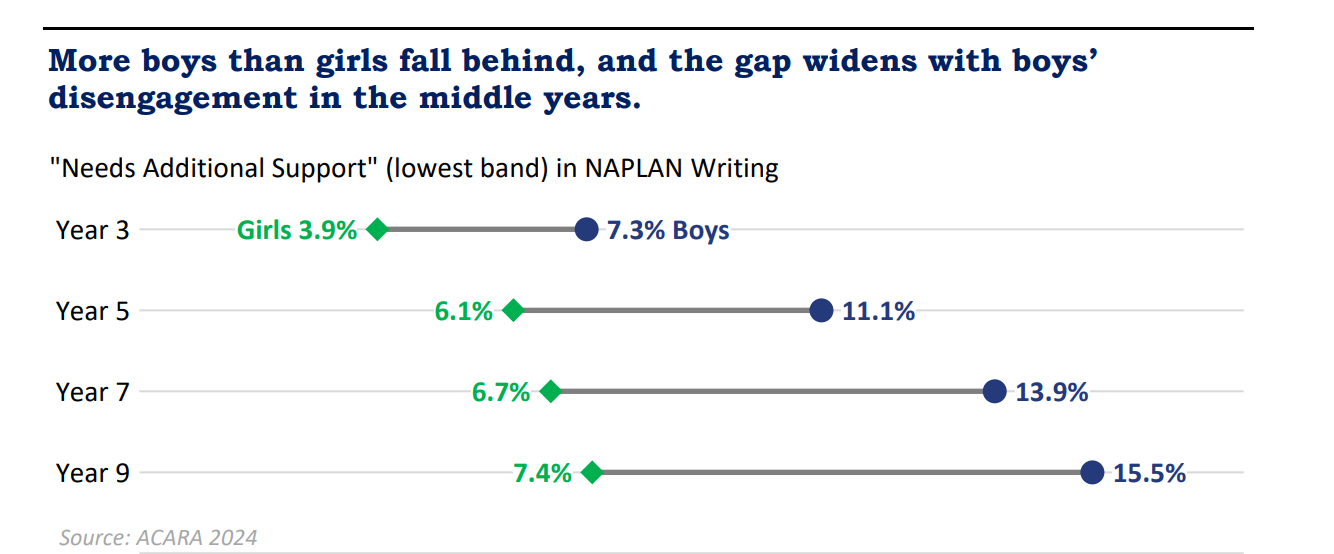
Meanwhile, international assessments confirm that boys are over-represented among students struggling, even in mathematics, traditionally considered the strongest domain for boys.
As Leeser pointed out, the gap is evident in higher education, too.
“By last year, 37 per cent of women between the ages of 15 and 74 had a degree at bachelor’s level or higher, compared with 30 per cent of men in the same bracket.
“If you drill down into the 25-34 age bracket, 41 per cent of men, but 54 per cent of women, have a bachelor’s degree or higher.
“It is fair to say now that not only are Australians better educated in general than they were 30 years ago, but that women are better educated than men.”
Of course, problems for boys in school can have decidedly negative flow-on effects.
The Organisation for Economic Cooperation and Development (OECD) has warned boys who lag behind and lack basic proficiency in reading may have trouble accessing further education, desirable jobs and reaching ‘full personal development’, noting boys are significantly more likely than girls to be disengaged from school, get lower marks, repeat grades, and play video games in their spare time.
For the first time, the proportion of young men who have dropped out of the workforce exceeds that of young women.
Meanwhile, unemployment among young people aged 15-24 is markedly worse for men (11.3 per cent) than for women (8.2 per cent).
“Crucially, the pool of academically underperforming school students, who will make up the bulk of those falling out of the labour force, contains far more boys than girls,” Catholic Schools NSW’s report flags.
The tail of underachieving boys is a huge issue often masked by a focus on the ‘average boy’, researchers say.
“This mirrors broader patterns in society, where the direction of gender disparities varies by the point on the totem pole; 78 per cent of Australian CEOs are men, and the average male earns 21.8 per cent more than the average female; yet equally, men make up 92 per cent of Australia’s prison population, 75 per cent of suicide deaths, and more than two-in-three drug or alcohol-related deaths...”
As the report sums up, “successes for men at the top offer no relief to the misfortunes of those men at the bottom.”
So what is behind boys’ disengagement and lagging academic performance at school?
While numerous theories abound, no consensus on the root causes prevail, researchers assert.
Biological differences, behavioural issues, different hobbies and interests (ie. less enthusiasm for reading), and the impacts of cultural stereotypes have all been floated by researchers.
Glen Fahey, education program director at The Centre for Independent Studies, has previously noted boys seem to be disproportionately impacted by two prevalent but low-impact practises: inquiry learning and ‘so-called’ innovative classrooms.
“Being a boy is increasingly an educational risk factor,” Fahey told The Financial Review in 2022.
“It deserves more attention in both policy and practice.
“We continue to see a steady increase in the number of boys not meeting the national minimum standard at all levels (in NAPLAN).
“Boys’ literacy remains one of the most significant and under-discussed educational factors in the education system.”
EducationHQ has contacted experts in boys’ education for comment.