E.D Hirsch’s The Schools We Need: and why we don’t have them proved to be profoundly influential for the National Party Minister, serving as the impetus for the bold school improvement agenda that’s currently playing out in classrooms across the country, Stanford has revealed.
Speaking at a recent Centre for Independent Studies event alongside Education Minister Jason Clare and Sir Nick Gibb (who served as England’s Minister for Schools for a decade leading evidence-based reforms that transformed English education through systematic phonics, a knowledge-rich curriculum and structured maths teaching), Stanford said before happening upon Hirsch’s insights, nothing was quite adding up.
“I was scratching my head as to why our results were so poor, why they had declined so much in PISA and PIRLS and TIMSS, even our own assessments were going backwards,” she told the room.
“[I] learned about the reading wars and the controversy of sounding words out, and that that was somehow controversial.”
It was the exact same realisation that Gibb had experienced ten years earlier, in what is an ‘eerily similar’ story, Stanford reflected.
“I spent a lot of time in Opposition getting ready for government and creating policy.
“We wrote hundreds of pages of documents … and boiled it all down to our education policy going into the election, which was ‘teaching the basics brilliantly’.
“And those hundreds of pages all came down to: ban cell phones, we’re going to do an hour a day of reading, writing and maths, and we’re going to introduce structured literacy.”
Excited by the evidence base opening up before her, Stanford buried herself in literature, seeking out prominent Australian and US academics who were advocating for evidence-based instruction.
“I read about people like Jennifer Buckingham. I met [Professor Pam Snow] and [Dr Lorraine Hammond] and read about Nathaniel Swain …. and Anita Archer and Natalie Wexler from America.”
The learning curve was about as steep as they come, she admitted.
“We read about what they were doing, the science of reading and the science of learning, and understood about what we needed to do to effect change.
“I don’t have a background in education, but very quickly tried to become an expert.”
Stanford said it all boiled to a very simple message that her Party took to the public in 2023.
“We are aspirational for your children, and we want to raise achievement, is literally all of the things that I say.
“Because every single parent, no matter their persuasion … they all want the best for their children. We are speaking directly to parents, ‘we want that, too’.
“And we have the data, the evidence, the science, we understand cognitive research, we understand the science of learning, we know how the brain learns.”
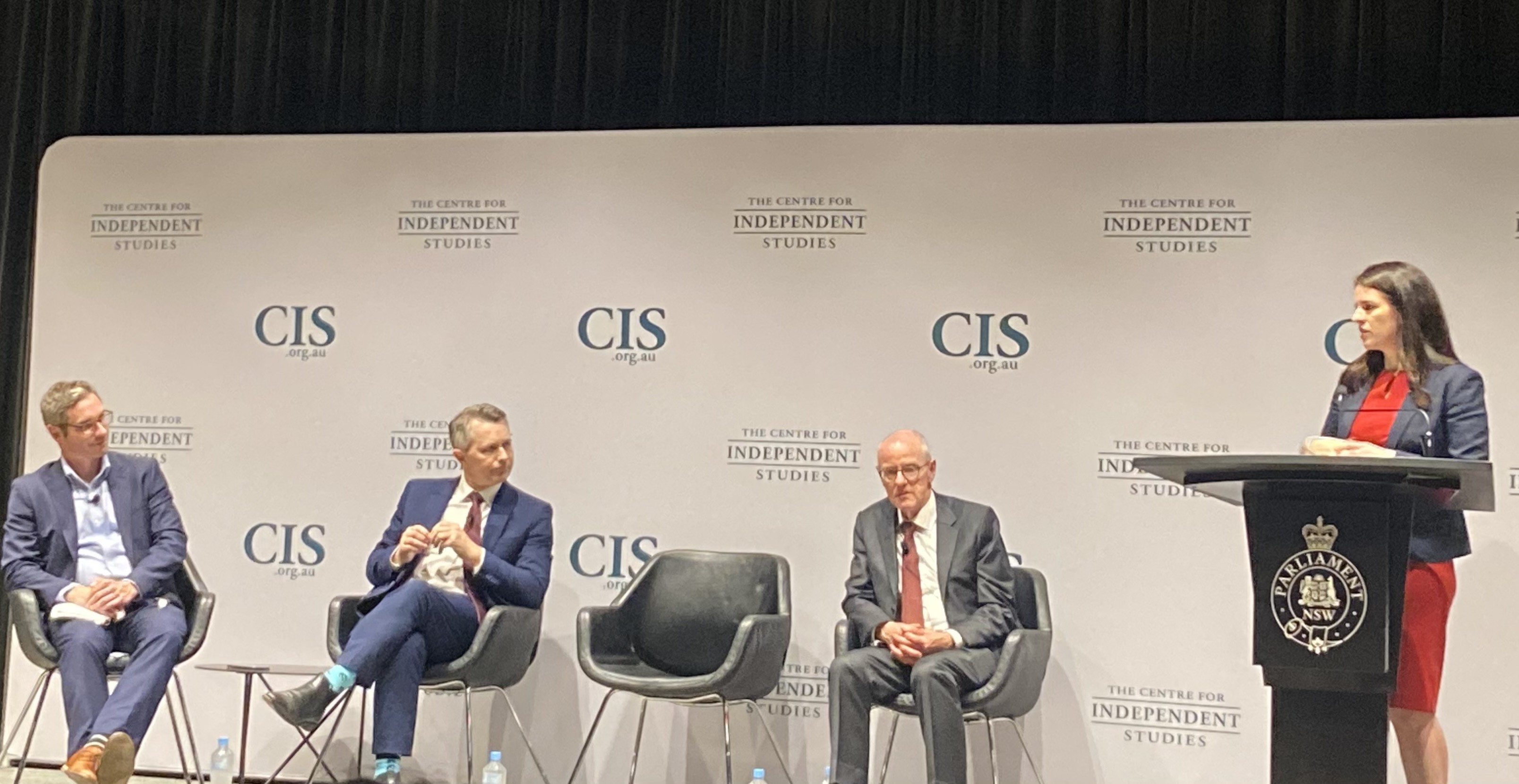
From left, host Glenn Fahey from the CIS, Education Minister Jason Clare, England's former Minister for Schools Sir Nick Gibb and NZ Education Minister Erica Stanford talk policy reform for school improvement.
Stanford is now blisteringly clear on the levers she says have to be pulled simultaneously in order to shift the dial on student achievement at scale.
The first is having a knowledge-rich curriculum in place, she said.
“…in order to get those higher order thinking skills and all the skills that we want in our children, they have to know some stuff.
“They have to be able to use that information that they’ve got to think critically. “
Quality assessment to catch those children who fall through the cracks, coupled with rigorous learning support to catch them up – as well as access to evidence-based PD for all teachers – round out Stanford’s priority list.
“We have been driving this hard over the last 18 months, because you miss out one of those things and the whole thing falls apart.”
Stanford has copped heated criticism for causing ’change overload’ for teachers, with some saying the reforms have been rushed through without proper consultation with the profession or with adequate supports in place.
Kerry Hawkins, principal of Waverley Park School in Invercargill, told teachers’ union NZEI Te Riu Roa that he’d seen a pace of change unprecedented in his 40 years as a school leader under Stanford’s leadership.
“This is the most absurdly paced policy change I’ve seen. My initial reaction was gnashing of teeth and frustration at the lack of consultation and respect shown to the profession.
“The mathematics programme we use is DMIC (Developing Mathematical Inquiry Communities). It is culturally appropriate, well-grounded in research, and proven to be effective. Why would we replace it?
“I’m starting to feel that curriculum changes under this government are like New York taxis: Wait a moment, and you’ll get another one.”
A recent poll by the union found 96 per cent of primary school principals report the cumulative effect of curriculum changes and increased workload has adversely impacted their health and wellbeing.
Some 73 per cent said they are likely to quit within the next five years due to the situation.
In an open letter to Stanford penned this week, the Rotorua Principals’ Association expressed deep concern over the Government’s curriculum implementation process and the “lack of genuine consultation”, calling for timeframes to be extended.
“This is the third time in two years that the English and Mathematics/Statistics curricula have been changed.
“With such significant and repeated changes, schools need adequate time to explore, understand, and unpack these documents, supported by bespoke and effective professional learning and development (PLD),” the letter reads.
The association also warned that moving to a knowledge-rich curriculum was a “massive undertaking”, arguing the current implementation agenda was completely unrealistic.
“We believe this entire process must be reviewed to enable genuine collaboration with key stakeholders-namely principals, leadership teams, and teachers who know what works for ākonga.”
But Stanford said there’s an urgency to the Government’s work here that cannot be ignored.
“In New Zealand every single year, 60,000 children start school. Every year you miss, and think, ‘oh, we’ll just put it off another year, we’ll have another thinking about it’, or ‘we’ll put our curriculum reform off’, or ‘we’re not quite ready yet’, those kids are another lost generation.
“Because half of our kids at high school at 15 are not confident or capable at reading or writing or maths.
“We test them at age 15 and half are failing and they should be able to pass ... so that’s the state of things, and what’s driving me…”
One principal from South Auckland, serving some of the poorest communities, told the Education Review Office her Year 2 students were now “reading words they couldn’t even look at before”.
There are also reports from teachers that structured approaches have transformed classroom behaviour for the better.
Since assuming office, 30,000 teachers have been trained in structured literacy, some 80 per cent of the primary teaching workforce, with phonics screening checks done three times a year now in place, Stanford reported.
Schools have also been ‘flooded’ with maths and literacy resources aligned with the science of learning, she noted.
“We’re now just starting to see the fruits of (all) that.”
Three terms in, Stanford revealed phonics proficiency has climbed from 36 per cent of children tested in Term 1, to 58 per cent in Term 3.
“For what it’s like being a minister, and for all of the things you have to put up with, it melts away when you are seeing the fact that children are learning to read for the first time.
“That’s why you come to politics and why you’re doing what you’re doing,” she said.
Clare’s current bid to ensure every Australian teacher is using explicit teaching is “an absolute marvel”, Stanford added.
“We need to do that in New Zealand as well, that’s our aim, to see all teachers using a knowledge-rich curriculum and explicitly teaching.
“It just goes to show that this is not [a left or right political agenda], this is about children learning to read, learning to comprehend what they’re reading and there’s nothing more important than that.
“It’s really nice to be here … with Labor ministers who are doing exactly the same thing and are just as passionate and excited about all this as I am.”