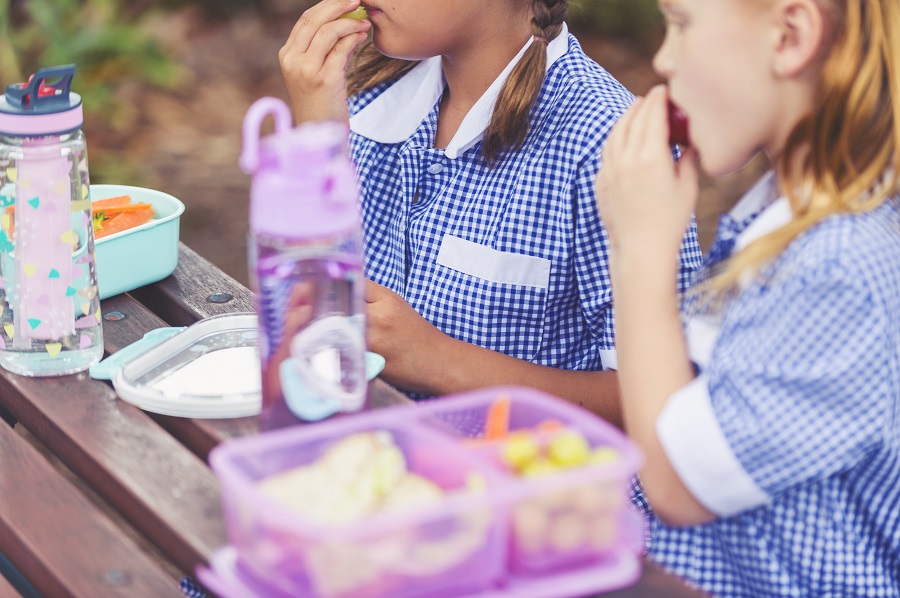
And it’s probably fortuitous, given that despite 20 years of campaigns to encourage better childhood nutrition, evidence suggests that nearly half (44 per cent) of the foods Australian children eat at school are energy-dense and nutrient-poor (otherwise known as “discretionary foods”).
A team of researchers led by Flinders University’s Caring Futures Institute surveyed almost 400 parents of primary school children last year, finding 93 percent of parents were interested in school-provided lunches and willing to pay for them.
Nutrition quality, menu variety and environmental sustainability were found to be of most importance for parents when considering a potential school-provided meal system.
“There is growing momentum across Australia for rethinking how food is provided in schools, with research showing school lunches can reduce stigma and increase social equity, alongside improved nutritional and learning outcomes,” Professor Rebecca Golley, project lead of Flinders University’s school food research program, says.
“Parents are a really important interest holder for any new ways to nourish kids while at school.
“For a school lunch program to be financially viable, commitment and investment from families is going to be key.”
Golley is a professor of Nutrition and Dietetics and says her team’s research shows that Australian parents are willing to invest in a different future for school food and are willing to contribute financially.
“Parents have also highlighted what matters to them. This is important because a new system that reflects parental needs is more likely to be successful and sustainable.”
The research tested six key components of a hypothetical school-provided lunch model, including cost, nutrition, sustainability, menu options, access, and a whole-school approach to food, in order to determine the trade-offs between these factors for families.
“Nutritional quality of the meal was the strongest driver of parents’ hypothetical choice to participate in a school lunch program with parents overwhelmingly favouring menus that focussed on nutritious food, made from quality ingredients, ahead of other factors,” study lead author Dr Alexandra Mason says.

Today, an estimated 466 million children receive school meals globally, yet there remains limited information available about the nutritional quality of the food they are served.
“Menu variety was the next most important consideration, with strong preference for having two meal options rather than a single dish.
“Parents did also note the potential for the program to expand their child’s palate, expressing an interest in children trying a wider range of foods.”
Environmentally sustainable systems and approaches that integrated food education, positive messages and learning about healthy eating across the school day, were also highly valued.
“Predictably, the survey found the lower-cost options were more appealing, but parents did demonstrate a clear willingness to pay for programs to go beyond just providing something to eat and instead focus more on food quality, sustainability and linking to curriculum,” Mason says.
“On average, parents reported spending around $6 per day on lunchboxes and said they would be happy to pay a similar amount for a school-provided lunch.
“Although it’s worth noting preferences and willingness to pay differed across sociodemographic factors, including household income and number of children in school, indicating there is a need for a system that can be tailored for different families,” Mason explains.
The research team says the study’s findings provide strong evidence to inform the design of an Australian school meal system that meets parent expectations and supports child health and wellbeing.
“We know from universal school meal systems in other countries that the benefits range from improved nutrition and learning outcomes, to better social equity,” Golley says.
Many parents in the survey were motivated by the idea that all children would receive the same meal, with 70 per cent saying they valued the potential for equal and stigma-free food provision.
“These results give policymakers valuable guidance on what families consider essential for a school-provided meal program. Parents are a key stakeholder, and their preferences must be considered alongside those of educators, policymakers and children themselves,” Golley shares.
The study release coincides with a new global guideline released by the World Health Organization (WHO) which claims that healthy food in schools can help children develop healthy dietary habits for life.
For the first time. WHO is advising countries to adopt a whole-school approach that ensures food and beverages provided in schools and available throughout the broader school food environments are healthy and nutritious.
Putting its words into action, WHO has just released a new global guideline on evidence-based policies and interventions to create healthy school food environments.
Childhood overweight and obesity are rising globally, while undernutrition remains a persistent challenge and schools are on the front line of this double burden of malnutrition.
In 2025, about 1 in 10 school-aged children and adolescents – 188 million – were living with obesity worldwide, surpassing for the first time the number of children who are underweight.
Children, WHO said, spend a significant portion of their day in school, making it a critical setting for shaping lifelong dietary habits and reducing health and nutrition inequities.
Today, an estimated 466 million children receive school meals globally, yet there remains limited information available about the nutritional quality of the food they are served.
“The food children eat at school, and the environments that shape what they eat, can have a profound impact on their learning, and lifelong consequences for their health and well-being,” Dr Tedros Adhanom Ghebreyesus, WHO Director-General, says.
“Getting nutrition right at school is critical for preventing disease later in life and creating healthier adults.”
Here in Australia the Caring Futures Institute research team in 2026 is leading a national project that will look at 36 schools as they introduce different approaches to feeding kids at schools.
“This is an important project to build the evidence base for doing school food differently in Australia,” Golley says.
“Schools around Australia are trying some really innovative programs. What we need is a national evaluation framework to build national evidence of the benefit of ‘thinking outside the lunchbox’.”
The paper titled, ‘Exploring Australian parent preferences for a school-provided meal offering using a discrete choice experiment’ can be read here.
To read more on this in The Conversation, click here.