
Leading international market research company, Ipsos, has released the latest edition of its ‘Education Monitor’ – a 30-country survey involving 23,700 respondents (including 1000 in Australia), which tracks perceptions of education systems and the use of technology in schools. This year it has also looked at the challenges facing young people.
According to the survey, when it comes to perceptions of our education system, 56 per cent of respondents rate its quality as ‘good’ – which on the surface appears to be less than impressive, however when compared to the global average of 34 per cent, looks far more encouraging.
Ipsos Australia deputy managing director, David Elliott, says the data suggests the Australian community recognises the difficult job that teachers have.
“When we talk about the greatest challenges, one-in-four said staff wellbeing,” he tells EducationHQ.
“So clearly, people recognise that teachers have a tough job.
“Similarly, they also said one of the challenges is inadequate teacher training – and that says to me that people recognise teachers have a really tough job and that things are changing so quickly, it’s about how do we better support them?”
Only three other countries had higher levels of positivity – Singapore (77 per cent), Ireland (71 per cent), India (65 per cent).
The survey found that people in NSW are more positive about their education system (62 per cent) compared to those in Victoria and Queensland (both 53 per cent).
In terms of the main perceived challenges for the system, lack of public funding (29 per cent) rated highly, along with Generative AI (29 per cent), overcrowded classrooms (27 per cent); and staff wellbeing (26 per cent) topping the list.
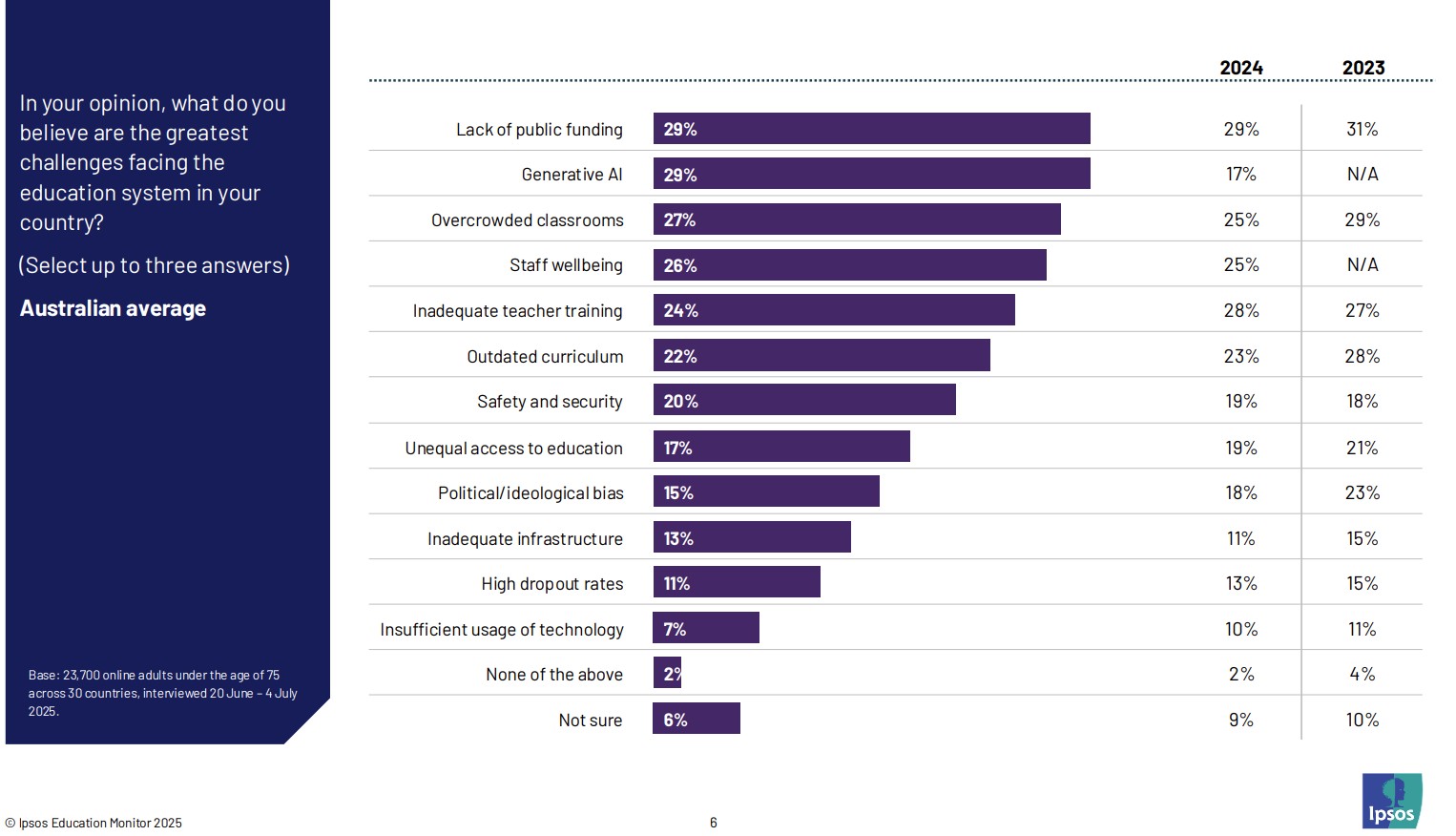
Interestingly, there's a large increase in concern related to AI, which jumped from 17 per cent in 2024 to 29 per cent, making us second only to Singapore (43 per cent) in viewing AI as a challenge to our education system.
Just under half of the Australians surveyed (47 per cent) support banning AI in schools, placing us in in fourth position behind Canada (55 per cent), Ireland (52 per cent), and France (51 per cent).
Elliott says over recent years, Ipsos has conducted research into how people are thinking and feeling about AI and Australia has tended to be more negative or less willing to embrace AI.
“When I saw the result for education [this time], that didn’t really surprise me, we do find we have less positive views about AI compared to a lot around the globe who are really looking to embrace it and move forward with it.
“I suppose the other thing I look at is, I suspect most people are looking at it from the perspective of students’ use of AI, rather than perhaps the opportunities it affords the education system and teachers to do things more efficiently or to change the way they do things which might give them more time to be doing other things.”
When it comes to support for banning social media access for children (under the age of 14), Australia is in sixth place (with 79 per cent), compared to the global average of 71 per cent.
Support for this kind of measure has strengthened by 8 per cent in Australia over the last year.
Elliott attributes this to media coverage of the under 16 social media ban and the increased discussion in society around the impact of social media, particularly in regards to cyber bullying.
“Concern over social media and young people is likely linked to community concerns about their mental health and bullying and peer pressure,” he suggests.
“To that end, while we compare well globally, we don’t have a particularly positive view of the mental health of our young people.
“We often hear about the pressures our health system is under regarding mental health, if our beliefs about our young people are correct, then mental health service provision is going to need a rethink from governments across the country.”
Not-surprisingly, support for the social media ban increases with age – 70 per cent of Gen Z support it versus 86 per cent of Baby Boomers.
Meanwhile, support in Australia (62 per cent) and across the globe (55 per cent) for banning smart phones in schools, whist not overwhelming, remains considerable.
“The lower level of support for a smart phone ban in schools is interesting, although it is likely an indication of lower levels of concerns because most schools and education departments around the country have already banned or restricted their use in schools,” Elliott says.
A pattern of increasing support with age is evident for mobile phones, however, Gen Z are much less in favour, with only 34 per cent supporting the ban, versus 63 per cent of Millennials, 71 per cent of Gen X and 82 per cent of Baby Boomers.
When asked what they thought were the greatest challenges facing young Australians, there was no standout issue among Australians, with ‘mental health challenges (depression, anxiety) mentioned by 38 per cent of respondents, and ‘bullying and peer pressure’ (37 per cent) being the top two.
‘Mental health challenges’ was much more likely to be mentioned in Queensland (47 per cent), while Victorians were much more likely to mention ‘gangs and youth violence’ (38 per cent).
Ipsos is the third largest market research company in the world, present in 90 countries and employing more than 18,000 people. Each month it runs a global survey on a topic of interest or a hot topic that’s going on in the world.
“There are a few that we think are important world issues that we track over time, education being one of them,” Elliott says.
“We like to measure and track and then obviously be able to make comparisons across the globe on how people are thinking and feeling.”