

Sharing a list of 50 known cognitive biases, including the bandwagon effect, the sunk cost fallacy and the curse of knowledge, the post caught the attention of an Australian research team from University of Queensland, who have gone on to investigate if rational decision-making can actually be taught in the classroom.
“We wanted to know whether or not that was true, whether it even worked,” Associate Professor Michael Noetel tells EducationHQ.
“Because these biases come up everywhere, behavioural economics has shown that they’re pernicious, that they’re very difficult us to change. We wanted to see if we could teach students how to change them.”
According to their recent findings, indeed we can.
In what is deemed the largest systematic review to ever examine cognitive bias education, the team canvassed 53 studies involving 10,941 participants, finding there are effective ways to teach students how to cut-through skewed cognition and to think with clarity.
This is a critical area of study, Noetel suggests.
“We think cognitive biases are really important for making good decisions. To be aware of those biases and be able to overcome them is a critical skill if we want to think clearly…
“If we’re seeing the world through very unclear glasses, it makes it very hard to make accurate judgments and make good decisions. And that applies to everything from financial decisions, being able to choose whether to buy a house, what house to buy, job decisions, relationship decisions.
“We know that a lot of these biases, like the sunk cost fallacy, for example, come up even in personal relationships or in jobs or projects that we’ve taken on.”
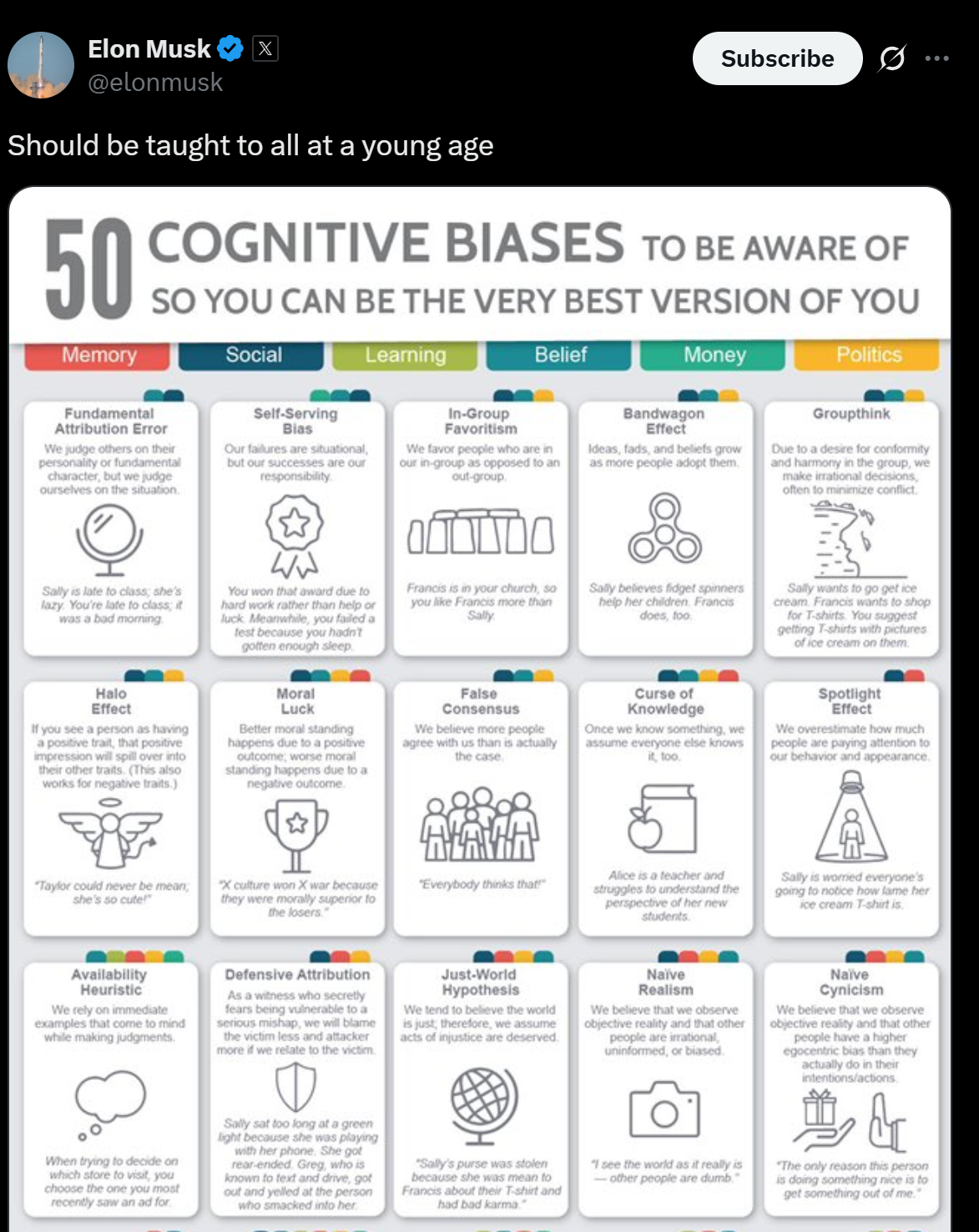
Noetel was surprised to discover that cognitive biases are not explicitly covered in the Australian Curriculum.
“There’s tangential mentions to it in some of the state philosophy curricula, but given critical thinking is seen in one of the core competencies that the Australian curriculum is supposed to target, not a single subject curriculum, even in psychology, covers the idea of cognitive bias,” he says.
We can’t simply assume students are learning about this elsewhere, he adds.
“I think you have to be careful not to design a curriculum where everyone thinks someone else is responsible, kind of like we’re doing a group assignment here as society, expecting that students are going to learn how to think critically and clearly.
“And as we all know in a group assignment, when it’s someone’s job to write the reference list, no one writes the reference list – unless someone has written in that it’s your responsibility.”
Whether it be false consensus, blind spot bias or otherwise, the expert says the most effective way to teach students to identify and change cognitive biases is through ‘hands-on practice’ and feedback, like that made possible via games and online programs.
Instruction alone had a weak impact, he suggests.
“The classic university lecturer (instructional style) was almost the worst-case scenario, and that’s because the students in the audience don’t really get a chance to make any judgments and get any feedback.
“Whereas video games that were designed to teach biases were the other end of the spectrum, because they’re constantly getting the student to make judgments.
“[But it’s not] just that ‘games work and lectures don’t’. The principle is trying to get students making lots of judgments to see if they’re accurate. And so for educators, that might mean using a website like Fakebook, which is free, where students make predictions either about the world or their own lives, and then they try to see how accurate that was.”
PhD candidate Ghassani Swaryandini, who led the study, explains the team looked at different types of biases and found some, like overconfidence, were relatively easy to shift.
“Most people go on thinking they are above average drivers or believe a DIY job will only take a weekend because no one ever tells us otherwise,” Swaryandini says.
“As a result, we tend to only remember the times we were correct, but if we got proper feedback about our judgements, we could learn to be more accurate.
“Many biases can combine to have a big impact on the decisions we make, so training students on a range of biases was the most helpful.”
The researcher says targeting and reducing bias is especially critical in the age of misinformation and AI.
“Cognitive bias plays a role when people fall into echo chambers or conspiracy theories, so the earlier we address that, the better,” she adds.
“While people can never be completely bias-free, it is reassuring you can start challenging ways of thinking during high school and university, setting up more opportunities for rational decision-making throughout life.”
Noetel says given the prominence of cognitive bias in public consciousness, it’s extraordinary they do not feature in the national curriculum.
“… you know, the first Nobel Prize ever given to a psychologist was [for identifying] a bunch of these cognitive biases, (so it’s surprising) it’s in none of the Australian curricula, despite the focus on developing critical thinking.”
Influential educational psychologist John Sweller has previously argued that there’s no evidence of any instructional strategy that can actually teach critical thinking.
According to Sweller, it’s only domain-specific knowledge stored in long-term memory plus our innate ability that allows these capabilities to flourish.
“At the end of the day, if you can think critically (or creatively) about something, it’s because you have a lot of knowledge about it,” he previously told EducationHQ.
Noetel maintains that students can and should be taught how to make sound decisions.
“I don’t think you can [do that] without identifying ways that those decisions go wrong. Cognitive biases are the most predictable ways in which decisions go wrong.
“And our research today shows that you can teach students to overcome a range of these biases in a relatively short period of time.
“So, I think the Australian curriculum should include something about decision-making, because it affects every domain of our lives, from our dietary choices, our personal choices, our financial choices and our career choices,” he says.