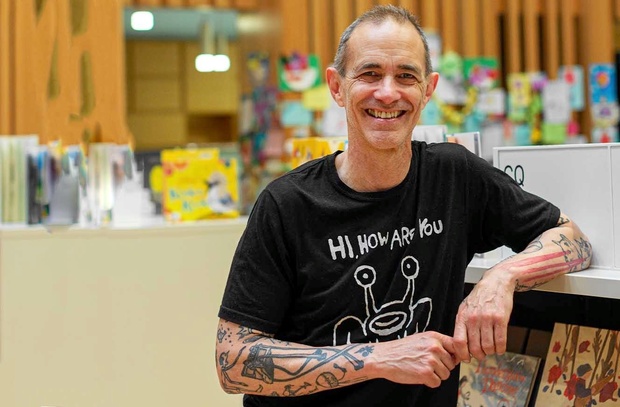
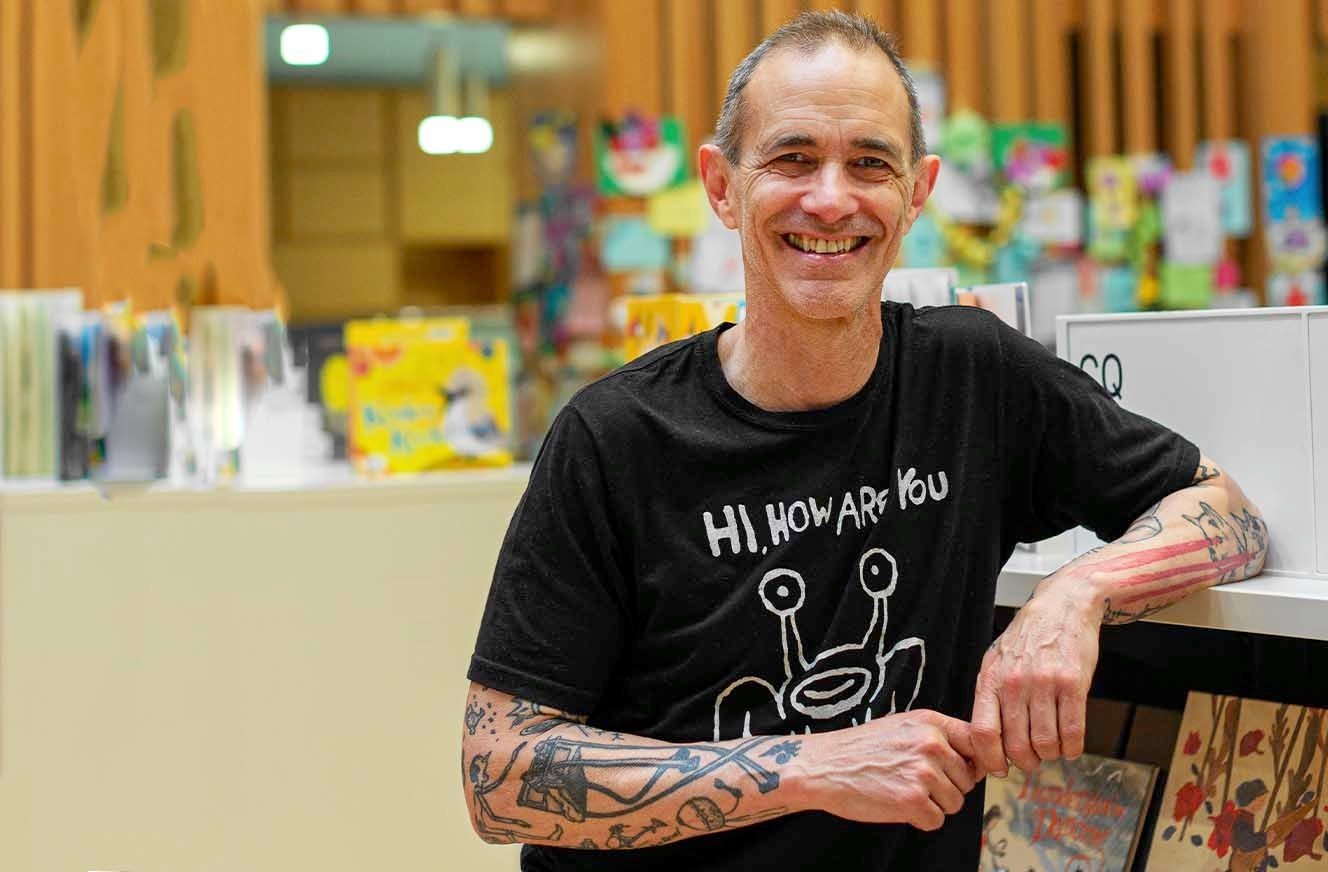
Much loved children’s author Andy Griffiths is following in the footsteps of a veritable who’s who of children’s literature giants in this country, including Gabrielle Wang, Alison Lester, Jackie French, Leigh Hobbs, Morris Gleitzman, and most recent Laureate, Sally Rippin.
Griffiths’ books have sold over 20 million copies here and overseas and include the JUST! books, the brilliant Bum trilogy, the Treehouse series and his latest book, You and Me and The Land of Lost Things, which features the reader as one of its main characters.
Having once been a lead singer in an alt-rock band and a high school teacher, he’s won 80 children’s choice awards and 10 Australian Book Industry Awards and is an ambassador for The Indigenous Literacy Foundation and the Pyjama Foundation.
“I wish schools would concentrate on literacy, the pleasures and the power that comes from just reading for enjoyment, because literacy underlies all achievement, whether you’re in primary or secondary school. And I just wonder how much emphasis is given to imagination in the high school curriculum,” Griffiths tells EducationHQ.
“I don’t know if it’s even a criteria for most subjects, and yet that’s what we want from someone who’s leaving school. We need to have some with rich imagination because that’s how you solve problems.”
The Children’s Laureate is an ambassadorial role for reading and Australian children’s literature, championing important issues affecting the industry, including creators, reading advocates, educators, librarians, booksellers and publishers.
During her two years in the role, Rippin, for example, focussed a great deal on her own experience with neurodiversity and creating public awareness around learning difficulties, including disability, mental health, access to books and language barriers, as well as the most effective approach to reading instruction.
Appointed every two years to promote the importance and transformational power of reading, imagination and story in the lives of young Australians, the Children’s Laureate travels the length and breadth of the nation, speaking directly with children, families, education specialists, government ministers and librarians, in both metropolitan and regional communities.
“When they asked me if would I consider it, I was like, ‘yes, this would be fantastic’ - because in a sense, I’ve always been on this path, being an ambassador for books, and passionate about connecting to the power of the book and the pleasure and the benefits that come from that literacy,” Griffiths explains.
“My publishing company, Pan Macmillan, right from the very early days, had me out on the road.
“They believe in putting authors with the readers, and it’s something that I really enjoy.”
“The right book in the right hands can change a child’s attitude to reading, and books and reading offer a particular type of experience – it’s personal,” Griffiths says.
Griffiths says being out and about has always been an integral part of his writing process, testing ideas on the kids and hearing what they would like to see.
He’s always getting a good sense of how to keep moving and ensure his books are relevant for each subsequent generation.
“I love families and kids. I love stirring kids up and provoking them and getting them arguing with me,” he says, laughing.
“They know what I’m saying often is outrageous, and they love to humour me - and not humour me.”
Griffiths also loves talking with parents.
“They’re seeing kids interacting really viscerally with ideas and imagination, and the parents enjoy it just as much. It’s a nice compliment. 'Oh, we thought that was going to be really boring, but we’ve really enjoyed it!' he laughs.
The author says he loves hearing that because reading starts in the home.
“If you have some parents who stock the house with books and then make a regular time to read, often at bedtime, that can set a kid’s very basic literacy, which they can then run with when they get to school with librarians who can take them to the next level by putting the right book in their hands.”
In the coming two years Griffiths also says he’ll relish more opportunities to talk to librarians and educators, “which is just as important in a way because they are the conduits”, he shares.
“We need schools with qualified librarians who are keeping up with what’s coming out and who know their children and know the books so that they can be sparking that interest all the time,” the author says.
“It distresses me when I hear [about schools where] the libraries are either optional or they’re non-existent or they’re being run by but non-qualified people. I think [these schools are] making a big mistake because literacy underlies everything.”
Griffiths’ approach with kids has always been twofold. It’s been to create books that are of high interest, high excitement, with a lot of humour, adventure and fantasy, but he’s also very much encouraged them to write and draw themselves too.
“Reading involves you collaborating with the author to build an imaginative world together,” he offers.
“When you’re writing and drawing, you’re creating your own world with your own intended audience, which may be your friends or family or teacher - but they’re two sides of the same coin to me.”
With the launch of his program taking place at a special ceremony at the State Library of New South Wales on Tuesday, Griffith is giving little away, but says for his role as Australian Children’s Laureate, he and illustrator Bill Hope have created a special book called Let’s Go, which includes a range of short models for kids.
“So there’s comic strips, cartoons, poems, very super short stories,” Griffiths explains.
“And there’s spaces within the book for the kids, inviting them to fill in their own ideas at certain points. It’s not an activity book as such, but it has that component - you can just pick it up and read it for pure pleasure.
“That’s what I’ll be advocating with the kids. Creativity and imagination is not the province of professional writers or illustrators - it’s everybody’s birthright.”
While primary-aged children show higher reading engagement, recent research shows reading enjoyment drops from 70 per cent in ages 6-8 to 46 per cent in 12-17 year olds.
Griffiths says he’ll be presenting in every state and every territory this year and next, and more than likely multiple times in some places.
“We’ve already got dates booked for Perth and Albany and Sydney and Bendigo and Brisbane, so, yeah, it’ll allow me to go far and wide.
“The Laureateship offers to me an increased ability to get out there and meet the kids in person that I wouldn’t normally have that chance to do.”
The latest research indicates there’s a concerning decline in kids’ reading habits, with one in three not meeting literacy standards and roughly 30 per cent of teens not reading for pleasure.
While primary-age kids show higher engagement, reading enjoyment seems to drop off from 70 per cent from ages 6 to 8, to 46 per cent in 12 to 17 year olds, and this is attributed to things like high screen time and a lack of positive reading role models.
“I do often think we need to be careful about imagining a golden age of reading where everyone used to read because there’s always been a lot of distractions and a lot of options for other forms of entertainment,” Griffiths shares.
“At the same time, I believe the right book in the right hands can change a child’s attitude to reading, and books and reading offer a particular type of experience - it’s personal, it involves a little more work on the reader’s part to, as I said, collaborate in conjunction with the author to create this story - but it gives you a very personal connection to the book and to the author.
“I can’t think that that’s replicated in many other art forms...”
Griffith says the key is keep that material at hand and understand that we’re competing against a lot of other distractions.
“Obviously screens are a big thing and adults play an important role in moderating that screen time and ensuring their child has balance - and perhaps it is about modelling some of the qualities that you would like your child, or student, to adopt.”