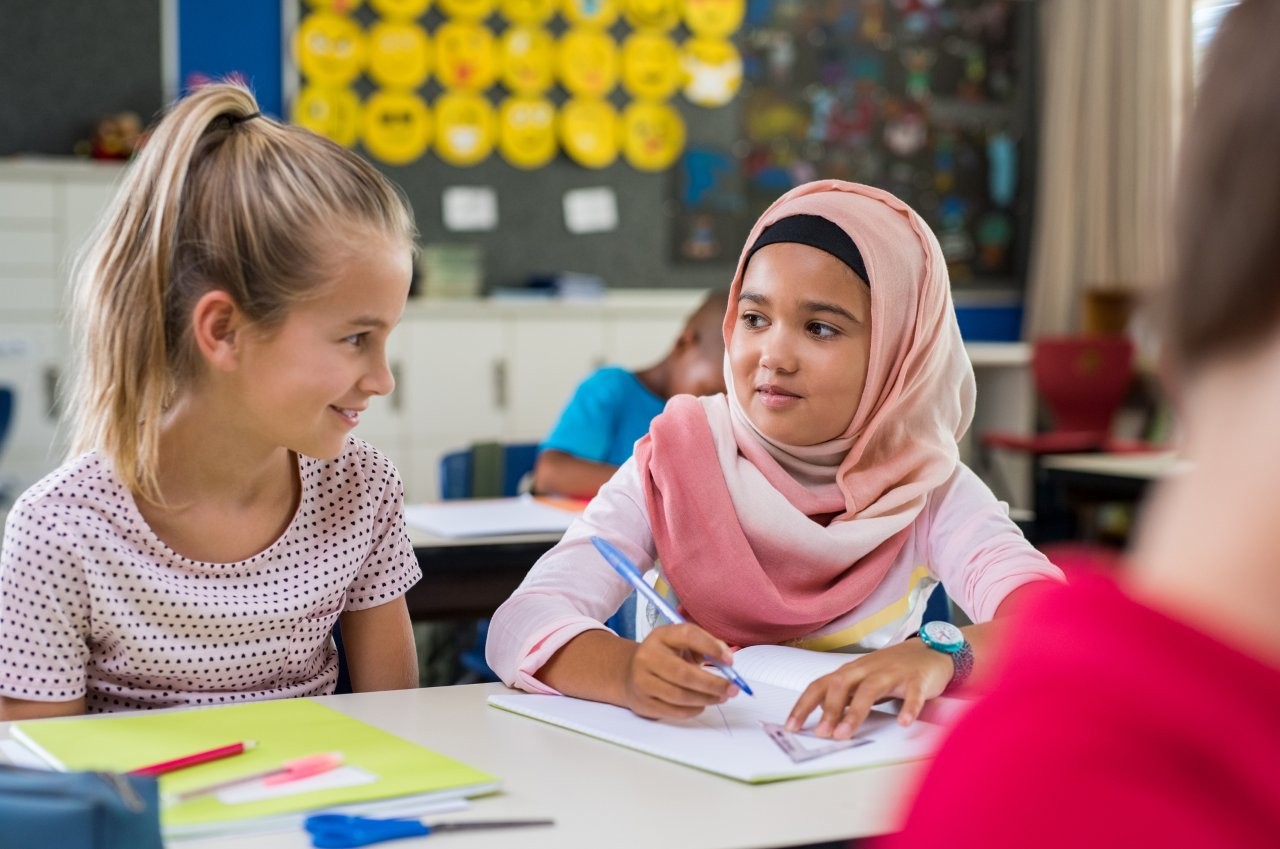
The ban, proposed by the ruling coalition of three centrist parties, was also backed by the opposition populist Freedom Party, which was alone in calling for it to apply to school staff as well.
The only party to oppose the proposed ban was the smallest in parliament, the Greens, arguing it violates the constitution.
Rights groups have criticised the plan.
Amnesty International said it would “add to the current racist climate towards Muslims”.
The body that officially represents Austria’s Muslims has called it an infringement of fundamental rights.
“This is not about restricting freedom but about protecting the freedom of girls up to 14,” Yannick Shetty, the parliamentary leader of the liberal Neos, the most junior party in the ruling coalition, told the lower house.
“It (the headscarf) is not just an item of clothing. It serves, particularly with minors, to shield girls from the male gaze. It sexualises girls,” he said.
The minister for integration Claudia Plakolm of the conservative People’s Party, which leads the ruling coalition, called headscarves for minors “a symbol of oppression”.
Austria’s Constitutional Court ruled in 2020 that a previous ban, which applied to under-10s in schools, was illegal because it discriminated against Muslims and the state has a duty to be religiously neutral.
Going against that principle requires special justification, it held.
Shetty said the government had commissioned a study that is still under way in an effort to meet that requirement, without elaborating on its content.
Education Minister Christoph Wiederkehr of the Neos said young girls were coming under increasing pressure from their families – and also from unrelated young boys – who tell them what to wear for “religious reasons”.
The Greens’ deputy parliamentary leader Sigrid Maurer agreed that is a problem and suggested interdisciplinary teams including representatives of the Muslim community be set up to intervene in schools when “cultural tensions” flare.
The ban applies to “headscarves that cover the head in accordance with Islamic traditions,” according to the text of the law, which will come into force at the start of the 2026/2027 school year.
This also includes coverings such as hijabs or burqas.
An “information phase” will begin in February to prepare schools for the new regulation.
In the event of violations, the school management should first hold a meeting with the girl concerned and her parents.
If the child continues to wear a headscarf, the parents must speak to the relevant school authority.
As a last resort, fines of up to €800 ($A1400) may be imposed.
Back in 2005 there were calls here in Australia to ban headscarves in our public schools, largely led by Liberal federal MP Bronwyn Bishop and Victorian Liberal MP Sophie Panopoulos, who argued they symbolised cultural clash and challenged uniform policies.
Bishop argued the hijab was used as an “iconic item of defiance” and a “clash of cultures” in state schools, distinct from Islamic private schools.
The campaign was largely rejected by state education ministers, Prime Minister John Howard, and Muslim community leaders who defended religious freedom.
While some specific school uniform policies in Australia have faced scrutiny, broader bans have not so far been implemented.
Victorian education guidelines, for example, encourage schools to include head coverings in uniforms to prevent students from needing exemptions, supporting inclusion.
While major bans have not been put in place, debates over religious dress (including the burqa or face veils) in public spaces and schools resurface periodically – Pauline Hanson’s recent Senate burqa stunt a case in point – with calls for general bans on face coverings also debated.
Cases arise where religious headwear clashes with specific school policies, leading to anti-discrimination complaints, but these are often resolved in favour of the student.
(AAP with DPA)