


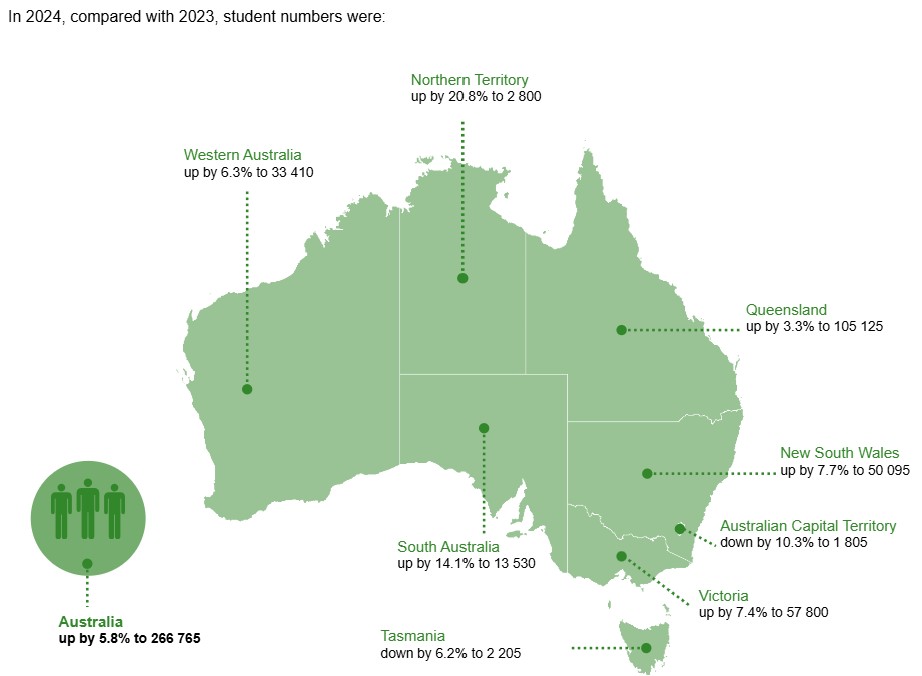
Significantly, data from the VET in Schools 2024 report reveals that the number of students engaged in VET has increased by almost 6 per cent from 2023, and by more than 55 per cent to its highest level since the data collection began in 2006.
In terms of program enrolments, the most popular training package was Tourism, Travel and Hospitality (56,740 or 15.5 per cent), followed by Sport, Fitness and Recreation (50,700 or 13.8 per cent), and Business Services (42,120 or 11.5 per cent).
NCVER managing director John King says the report shows that more than one-in-four students in Australia are doing vocational training as part of their senior secondary, with growth across all sectors, and particularly in government schools.
“VET is becoming a more popular option for school students who prefer hands-on learning, with more funding and support from government, schools and training providers,” King explains.
“What’s significant to me is when I go back and have a look at the long trends since 2006, there’s two things that stand out – the first is how we’ve seen this shift from lower level to higher level qualifications, and the other thing that I reckon is fascinating, is just how different it is across jurisdictions,” King tells EducationHQ.
“Back in 2006, about one-in-three VET in School students were doing a certificate one – today that’s not even one-in-10. And what’s changed is certificate three has gone from one-in-10, to one-in-three.”
“So we’ve seen this shift, and it makes sense. We want students to be studying at a higher level that’s still appropriate for their schooling. That gradual move away from cert one makes sense.”
Source: VET in Schools Report 2024
In 2024, the majority of VET in Schools students were enrolled in government schools (159,485 or 59.8 per cent), followed by Catholic schools (47,435 or 17.8 per cent) and independent schools (41,070 or 15.4 per cent). Government schools saw the largest growth, increasing by 5.5 per cent (8325 students) since 2023.
Nationwide, VET student numbers vary greatly, with increases everywhere except Tasmania and the ACT.
“In Queensland, numbers have gone from one-in-three to about one-in-two students doing VET in schools,” King shares.
“If you’re in the ACT, it used to be close to one-in-three, and now it’s one-in-10.”
“Jurisdictions clearly have different policies, different strategies for how much vocational training should be incorporated in their certificates, and that’s what we’ve seen over the long run. Some states have grown, others maintained, others have shrunk.”
King says with no major differences in Queensland’s economy or demographics, besides perhaps a higher ratio of tourism-based businesses, it’s likely that Government prioritising vocational training as part of senior secondary schooling is really having an impact.
“There are quite a lot of schools in Queensland that are also training providers, and while I don’t know if there’s a correlation, clearly Queensland’s view is we want more of it in schools compared to other states.”
“The majority we know are doing tourism, travel and hospitality, about 15 per cent sport, fitness and rec, the service industries are dominant in schools, which makes sense, there’s a lot of demand there.
“We know more students today are doing part-time work than they used to, and so there’s lots of reasons that we’d see growth.”
It’s well documented that as a nation, we won’t have enough graduates to fill roles in the energy and renewables sector over the coming decades.
Encouragingly, completions in Certificate II in Electrotechnology (Career Start) have grown to 3370 from 2580 in 2023 (an increase of 30.6 per cent), showing more school students are exploring a potential career in this area.
King says he’s optimistic we’ll see things trending upwards and that we might be better placed in the future.

“VET is becoming a more popular option for school students who prefer hands-on learning, with more funding and support from government, schools and training providers,” NCVER managing director John King says.
“We need more people with vocational training, particularly in those priority industries,” he says.
“I’ve observed state and territory governments trying to shift policy in schools so that more students are studying that way, and so we do see growth in some areas coming off a low base.
“What’s important, though, of course, is that it follows through either into a pathway into a higher level qualification after school or into work.”
We have to recognise, King says, that for many students vocational training is not about getting a job outcome, but that some are looking to stay engaged in education.
“I think we need to be realistic in how much we are getting students lined up for work and how much of it is about supplementing an education and keeping kids engaged that otherwise might drift,” he shares.
In 2024, there were roughly 4000 school-based apprentices and trainees representing about 8 per cent of all VET in Schools students, an increase of 151 per cent from 2023.
“I’m really enthusiastic about SBATs,” King shares.
“I think for certain students that are confident in that pathway, it’s a really useful way that they can get a foothold and a closer sense of what work is like in transition.
“We recently did some research on pre-apprenticeships and that showed that if you do a pre-apprenticeship, particularly in the trades, you’re more likely to go in there and you’re more likely to complete.”
Unlike some European countries, Australia does not have a system that streams students early, and while some states and territories are focussing more on SBATs, that share is increasing, but off a low base.
VET in Schools students by school type, 2023 and 2024, nationwide

Source: VET in Schools Report 2024
Broadly, King says the data shows that more and more students are recognising that doing VET in Schools is useful after school and useful in school, particularly in regards to part-time work.
“There’s clear demand in the labour market for those skills and I see more and more stories about the returns to doing vocational training.”
He’s hopeful that careers advice is strengthening and that more schools are placing emphasis on this critical resource area for students.
“Dedicated positions are ideal – just that other voice to a student at that critical time can make the difference between someone who’s 'one track' to higher education and someone who’s really weighing up whether there’s another path.
“My hope is that perception of vocational training is starting to change and we’re heading towards what Professor Barney Glover (Commissioner of Jobs and Skills Australia) calls a ‘parity of esteem’, where parents and students recognise that there’s a VET and a higher ed pathway after school, and both are feasible and both are valuable.”