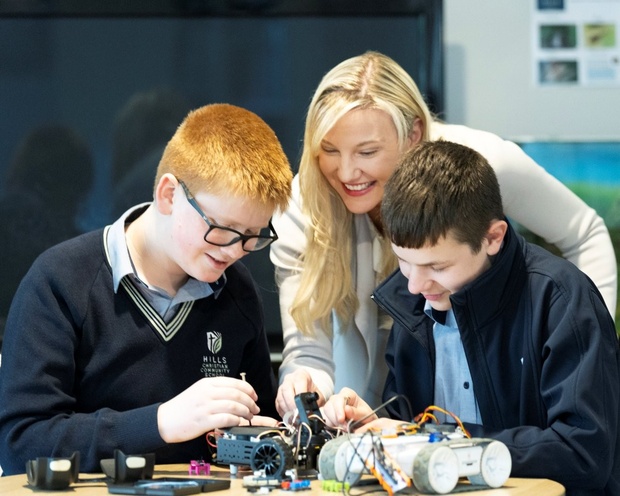
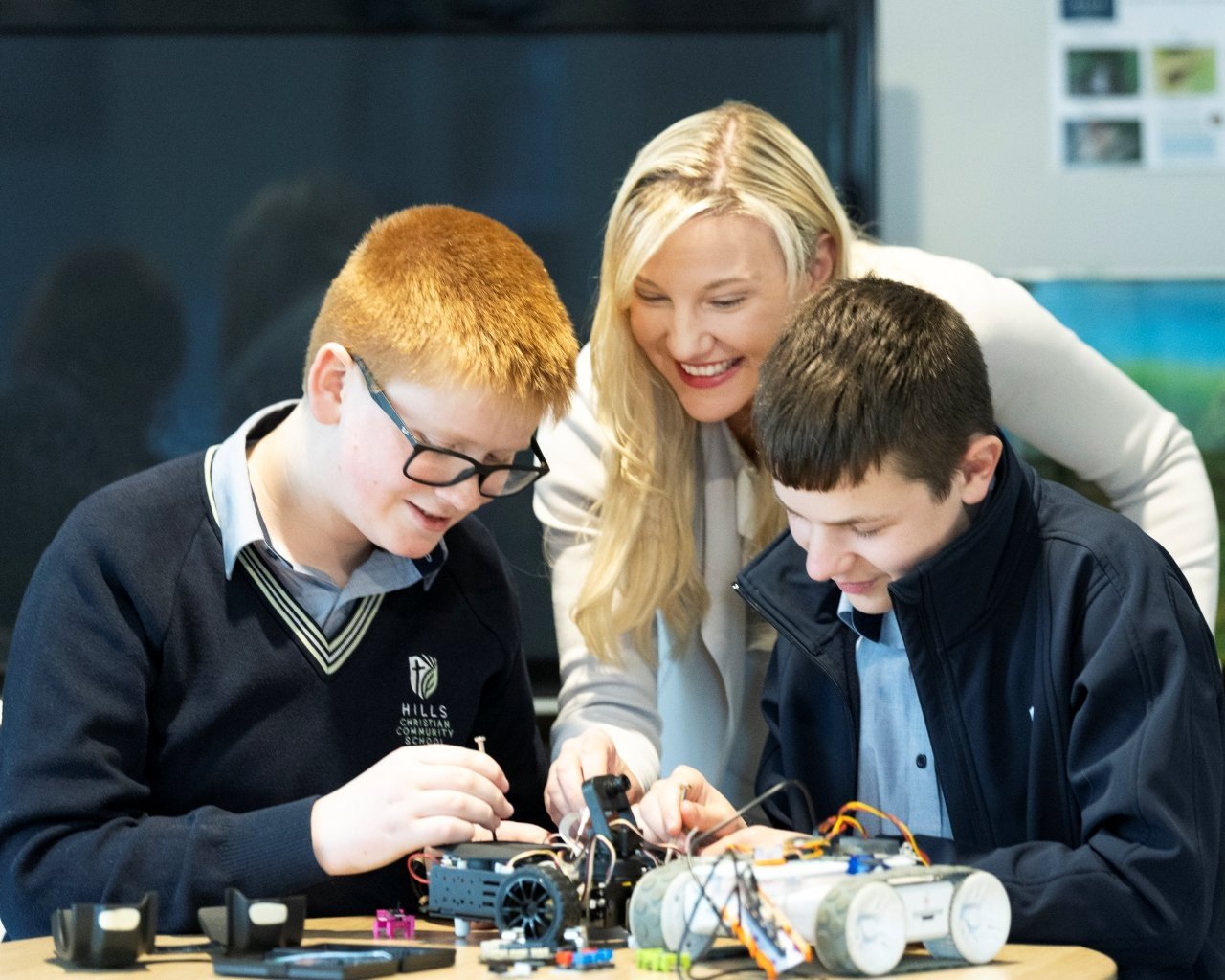
With its own waterway, the Onkaporinga Valley River, running through the school grounds, one of the school’s other major trump cards is its inspiring leader of digital innovation, Colleen O’Rourke, whose visionary STEM efforts exemplify equity, creativity and system-wide impact.
With nearly 40 percent of students at the school NSCCD (identified with a disability), O’Rourke’s work reimagines what digital learning can look like for neurodivergent children.
The Highly Accomplished and Lead Teacher (HALT), who’s been teaching for 20 years, was recognised this year with a prestigious Commonwealth Bank Fellowship, testament to her unceasing efforts to support her fellow educators, coaching and guiding them with digital tool integration.
Overseeing the inclusive ed team at her school and working with them to find digital tools that best meet the needs of her students, O’Rourke is also The Hills’ specialist digital technologies teacher and teaches from reception through to Year 10.
Originally a middle primary teacher, a return to university to lift her qualifications resulted in something of an epiphany for O’Rourke.
“I did my masters in leadership and wellbeing, and that’s when I really got the passion for supporting our neurodiverse students, because I realised there’s so many adaptive and inclusive technologies that can be used,” she explains.
“I recognised an opportunity with our unique school context, and I hate to make the blanket statement that neurodivergence students love nature and they love technology, but there was a digital dependence that was a huge problem, so I started about three years ago remapping the digital tech curriculum to make authentic connections back to nature.”
It was ‘crazy’ the impact it actually started to have for the school’s neurodiverse students, O’Rourke, who's been at The Hills now for 10 years, explains.
“When I say ‘connecting back to nature’ we make authentic connections from reception right through to Year 12.
“If we’re looking at the inputs and outputs of the digital systems, we cross compare with the inputs and outputs of a plant’s life cycle, we’re outdoors, we’re using augmented reality to draw parallels when we’re looking at swarm systems in nature, we cross compare with AI neural networks, we use UN sustainability goals for digital sustainable solutions – but everything we do in teaching digital literacy cross compares and connects back to natural systems.
“One of the key ones that we do that students always really love, involves looking at internet network systems, we cross compare with tree network systems and we look at the Mycorrhizal network that goes underground and for parallels – so it’s always drawing these authentic parallels to give kids a deeper appreciation and also designing for sustainability.”
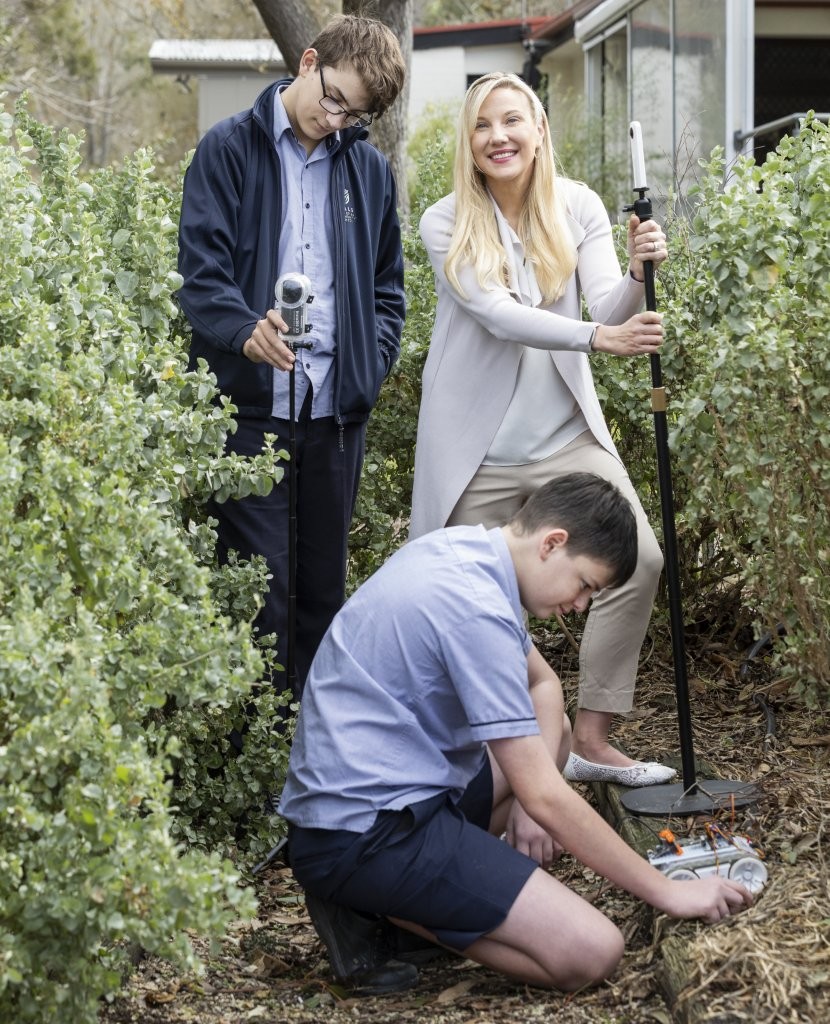
Whether co-developing cross-cultural VR storytelling projects with Nyangatjatjara College near Uluru or equipping teachers across sectors with accessible tech tools, O’Rourke’s work exemplifies equity, creativity and system-wide impact.
O’Rourke loves that because her program has so much wellbeing associated with it, the digital dependence element is minimised and mitigated throughout.
“I literally just got off the phone with a Tasmanian school this morning who’s interested in adopting our program.
“I couldn’t believe it garnered so much interest, but I think it was the sheer fact that digital dependence is a huge problem at the moment and kids are disconnecting from nature. We want to plug them back in while still building digital literacy.”
O’Rourke has long been using adaptive technologies and AI-driven differentiation to support students with ADHD, ASD, dyslexia and complex learning needs.
Her Digital Innovation Centre, built in the heart of the school’s nature play space, is a hub of immersive, interdisciplinary learning and beautifully showcases her commitment to a scalable, low-cost approach.
“We have an old farmhouse in the middle of our nature space, which I’ve done up as the innovation centre, and really it was the living version of the curriculum.
“We’ve used really low-cost tools for high-end outputs – so we’ve created a 360-degree immersive room where students can head outdoors with an outdoor microscope, capture what's under a mushroom and then project it all around the room. Our projection mapping system transforms spaces with projected visuals on each wall, and so you can be be in the mushroom, under the mushroom.”
For early years students, her team has built an augmented reality sandbox that maps out the Onkaporinga Valley River and creates stop motion animation.
“When schools come to listen and garner insight from the curriculum, they also look to the tools we’ve used that are applicable in schools that may not have the funding – so we always try and use open-ended free source tools or really cheap tools,” O’Rourke explains.
She’s extremely proud, however, that the program is not dependent on The Hills’ unique setting, but can also be taught “in the concrete jungle”, as she terms it.

Through her research partnership with UniSA, O'Rourke gathers valuable data and tracks measurable gains in student engagement, creativity and executive functioning.
“Because the connections can still be made even if you don’t have a nature space, so we’ve tried to design it like that as well, that it’s applicable anywhere even if it’s just drawing the connections and the students are learning about the science of nature.”
O’Rourke has a passion for her own school, but revels in sharing her expertise.
A regular presenter at EdTech SA, and Science Teachers’ Association and AI education summits, she’s grateful to be supported in her mission to better education opportunities.
“I’m exceptionally privileged to be working for a boss who lets me go out to speak and I love having the balance. I always say to people if I’m not teaching, I’ve got nothing to talk about.
“To be able to have the best of both worlds, where I can have an impact on educators and still be on the ground with the kids is my happy place.”
She loves that the program has so many elements to it that teachers can take whatever it is that they want to take away.
“I might just plant a seed or it might be the low-cost tools or the inclusive technologies that we use, or the XR technologies. I love that it can offer a variety and whatever is taken away, it's wonderful to have an impact even in the most minute way.”
Many teachers remain reluctant to embrace AI and utilise its many benefits, and O’Rourke has some sage morsels of advice.
“Lay your foundations first, make sure you’re using reputable tools,” she shares.
“You can speak to the ethics behind it, get your policies in place and once you’ve done that AI tools can be used for myriad purposes, whether it’s content creation and that’s the new way of it now, it’s no longer about just prompting anymore, it’s more about creating with AI and there’s so much potential.
“I’m a digital creative, so there’s so much potential for what students can start to create now using safe and reputable tools.
“My big thing that I like to say to educators, is make sure you’ve got all your ducks in a row – walk through it with the students, talk about the bias and the misinformation and as you engage with these tools with the students, be a model of ethical use of AI.”