


The mix of academic, behavioural, social and emotional demands faced by teachers means that their wellbeing may be strained. At the same time, there are many teachers who fare well and even thrive in the face of these challenges.
What is it about these teachers that helps them to navigate the profession and reap the rewarding benefits?
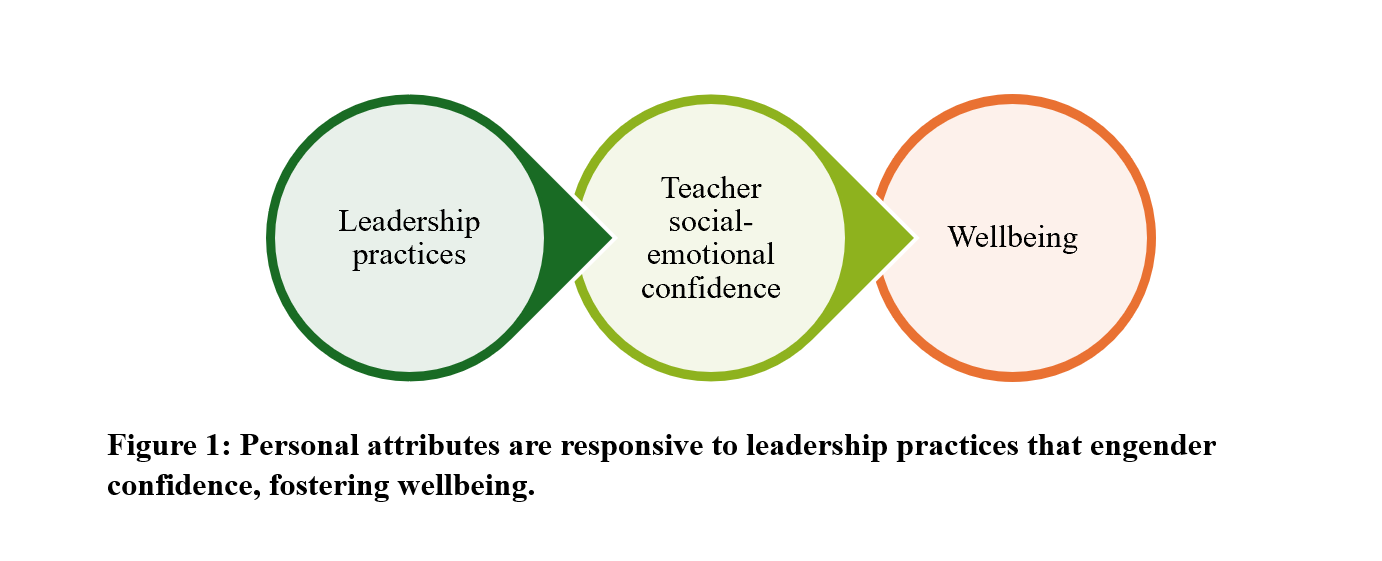
In this article we look at how teachers’ social-emotional confidence can make a difference, and the role of school leadership in supporting this – as shown in Figure 1.
Teacher Wellbeing
Teacher wellbeing matters not only for individual educators but is also a key contributor to the health and sustainability of the education system overall.
Teachers who experience high levels of wellbeing are more likely to remain engaged, productive, and pursue ongoing professional development.
The result of complex interactions between organisational factors and personal attributes, wellbeing is dynamic and changeable.
For example, teacher wellbeing is influenced by organisational factors including leadership practices, relationships with colleagues and students, time pressure, disruptive behaviour, and student motivation.
Organisational conditions clearly matter for teacher wellbeing; however, there are also other factors that play a role – particularly those relating to the individual.
As a result, research is increasingly paying attention to the personal attributes teachers bring to their work, and how these support wellbeing.
Among these attributes, teachers’ confidence in their professional capabilities has emerged as an influential resource.
Teachers’ Social-Emotional Confidence
Teacher wellbeing research consistently demonstrates that teachers’ self-belief about their ability to teach effectively is a key predictor of wellbeing.
For example, a teacher who trusts their ability to adjust a lesson for a struggling reader or extend a task for a high‑achieving student is more likely to experience their work as purposeful rather than overwhelming.
Alongside teachers’ confidence in their pedagogical effectiveness, an emerging area of research is looking at teachers’ social-emotional confidence. This reflects teachers’ belief in their capacity to manage social and emotional experiences central to their work.
In practice, social-emotional confidence might involve feeling equipped to regulate emotional responses during tense moments, build and sustain relationships, and express professional needs or boundaries with confidence.
Teaching is very much a relational profession, with educational outcomes grounded in constructive connections not only between teachers and students, but also with parents, colleagues, and school leaders.
Navigating these interactions is facilitated by interpersonal skills that can be integrated into the everyday course of teachers’ professional life.
Leadership Practices that can Support Teachers’ Confidence
As Figure 1 demonstrates, teachers’ social-emotional confidence has been identified as a personal attribute associated with wellbeing at work, and one that also appears responsive to supportive leadership practices.
This positions leadership as critical to nurturing and sustaining teachers’ relational capacity, and, in turn, their wellbeing.
Given all this, how might school leaders intentionally cultivate teachers’ social-emotional confidence in their everyday practice? Recent evidence suggests that autonomy-supportive leadership can boost teachers’ social-emotional confidence.
Such leadership is characterised by practices that empower teacher agency and initiative by identifying and nurturing professional strengths and preferences.
Examples of autonomy-supportive leadership practices include:
- Inviting staff input on decisions around policies and work arrangements;
- Developing rapport with individual teachers, seeking their perspectives and actively listening to their responses; and,
- Explaining the rationale that guide executive decisions.
It is through everyday interactions, and the accumulation of relational signals over time, that leadership influences teachers’ social-emotional confidence.
When teachers experience consistent messages of trust, respect and professional backing, it helps them to feel more confident to navigate relational challenges – these challenges feel more manageable rather than threatening.
In turn, this confidence helps teachers to experience wellbeing – they feel more positive about their work and are more engaged in the workplace.
Leadership practices therefore reinforce teachers’ existing strengths and support sustained wellbeing.
Teachers bring substantial personal strengths to their work. Supporting teacher wellbeing involves recognising, nurturing, and sustaining these strengths alongside efforts to manage external demands such as workload.
Teachers’ social-emotional confidence represents one such strength, shaped by experience and responsive to leadership context.
Supportive leadership practices represent an important avenue for fostering teacher wellbeing, and in contributing to the sustainability of the profession.