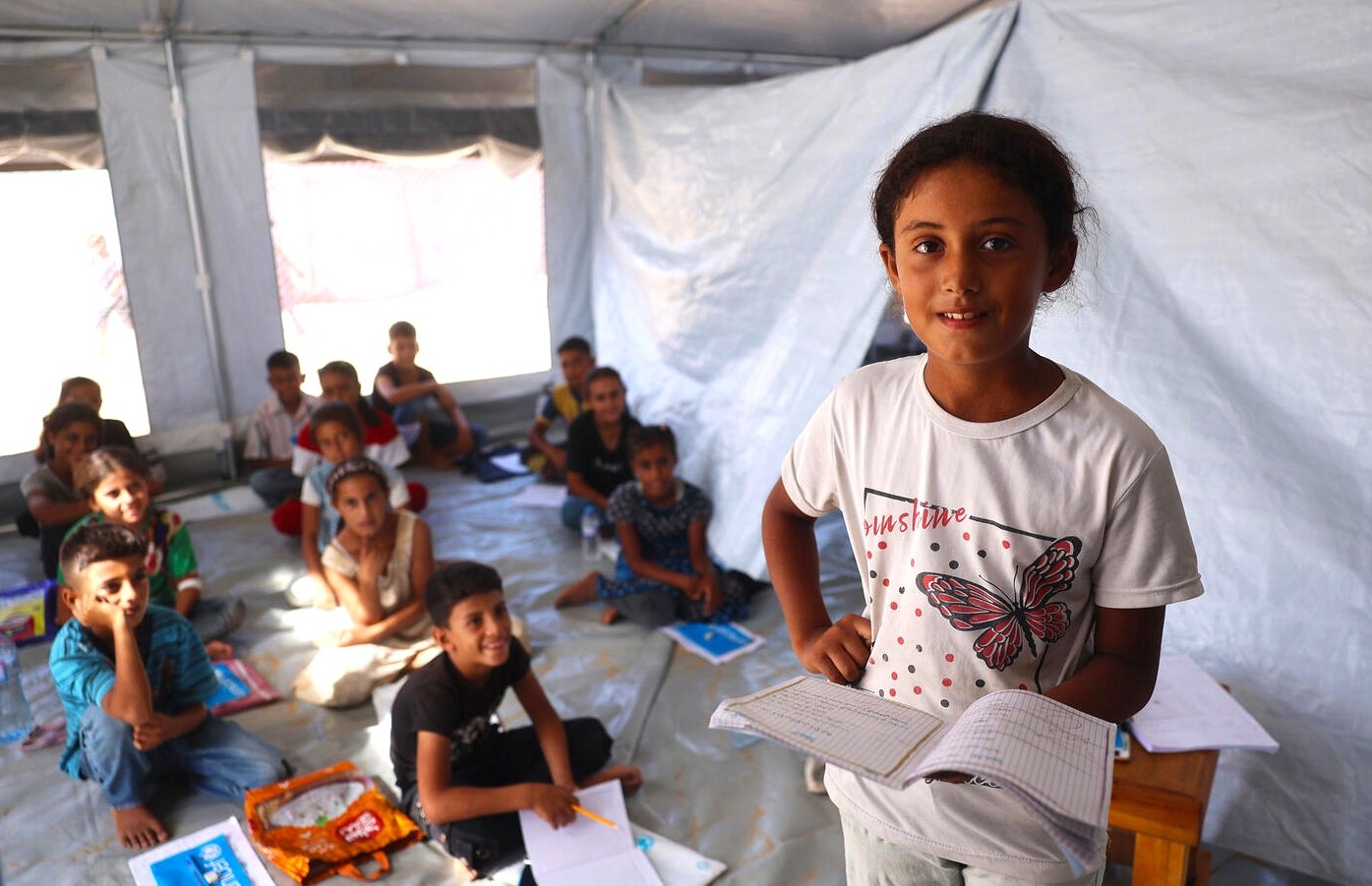
In one of the largest emergency learning efforts anywhere in the world, thousands of kits, including pencils, exercise books and wooden cubes to play with, have now entered the enclave, UNICEF said last week.
Attacks on Gaza’s schooling have left an entire generation at risk, with 60 per cent of school-aged children in Gaza currently having no access to in-person learning.
UNICEF, with education partners in Gaza and the Palestinian Ministry of Education, has launched an initiative called Back to Learning to restore access to education for hundreds of thousands of children.
The approach is straightforward and involves expanding a network of multi-service, non-formal learning centres, delivering education alongside mental health and psychosocial support and embedding strong governance and due diligence in one of the most complex environments on earth.
“We have now, in the last days, got in thousands of recreational kits, hundreds of school-in-a-carton kits. We’re looking at getting 2500 more school kits in, in the next week, because they’ve been approved,” UNICEF spokesperson James Elder said.
COGAT, the arm of the Israeli military that oversees aid flows into the Gaza Strip, did not immediately respond to a request for comment.
Children in Gaza have faced an unprecedented assault on their education system, with the teachers remaining, having to make do with limited resources, while children tried to study at night in tents without lights, Elder said.
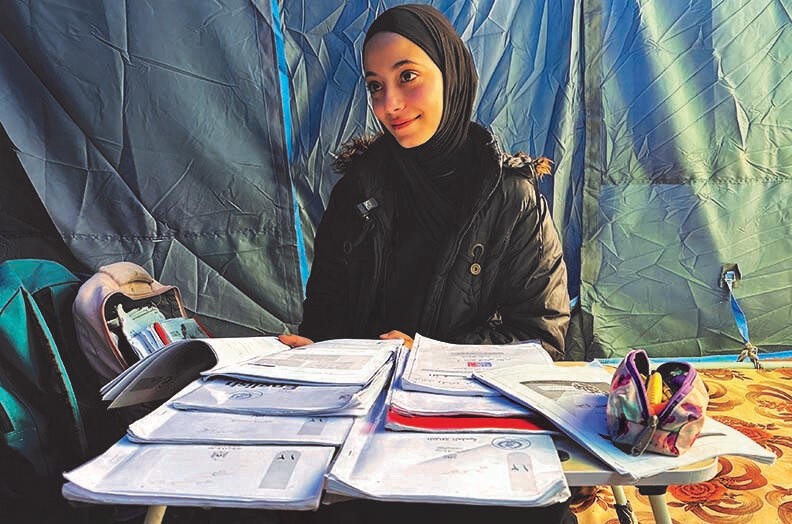
Jana,17, is studying for one of the most important tests of her life, the high school matriculation exam. She sits on the floor in her tent, while trying to keep borrowed text books dry despite winter storms and flooding. PHOTO: UNICEF
During the conflict some children missed out on education altogether, facing basic challenges like finding water, as well as widespread malnutrition, amid a major humanitarian crisis.
“Before this war, Palestinians in Gaza had some of the highest literacy rates in the world,” Elder said.
“Education was a source of pride, resilience and progress for generations.”
Today, he said, that legacy is under attack: schools, universities and libraries have been destroyed, and years of progress erased.
“This is not just physical destruction - it’s an assault on the future itself, because every child denied learning is a future engineer, doctor, teacher or thinker taken from us before they’ve had a chance to shape their world,” Elder explained.
“In the aftermath of this brutal war, rebuilding Gaza’s schools, educational facilities and universities must sit at the top of Gaza’s recovery agenda. Restoring education restores possibility.”
“It’s been a long two years for children and for organisations like UNICEF to try and do that education without those materials. It looks like we’re finally seeing a real change.”
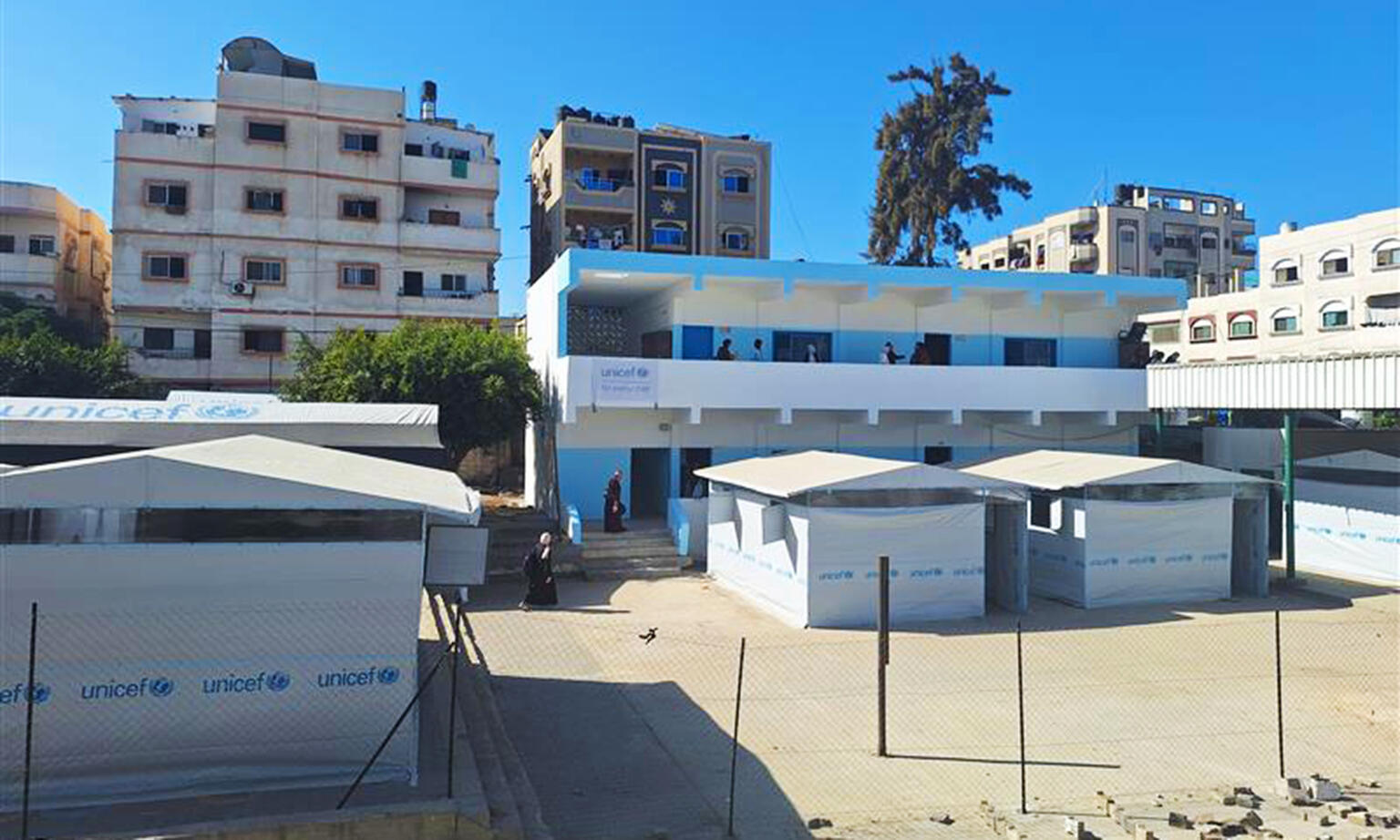
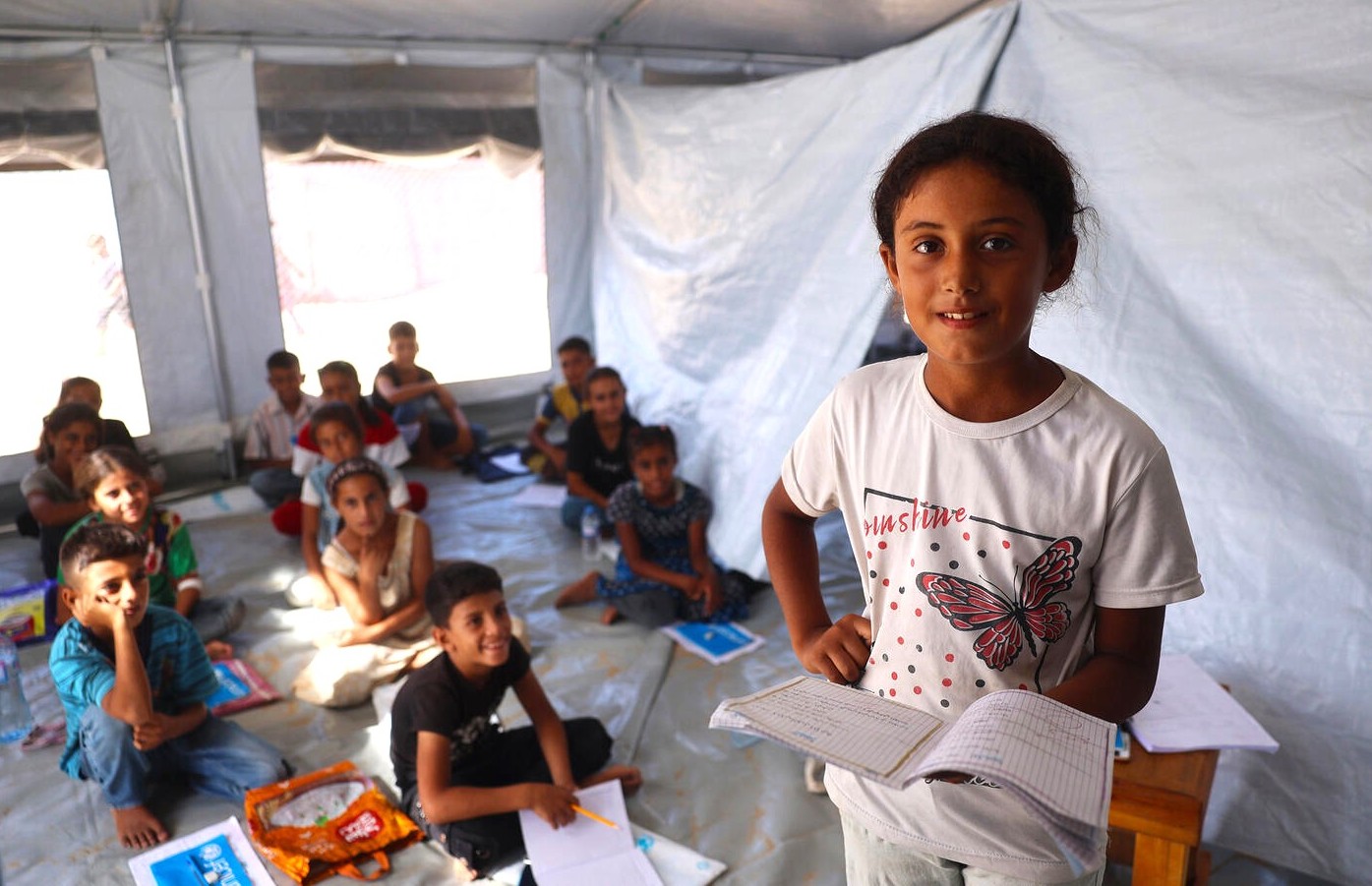
UNICEF’s temporary learning space in Deir al-Balah is critical, given other areas of the Gaza Strip are blanketed in rubble with few standing buildings. PHOTO: UNICEF
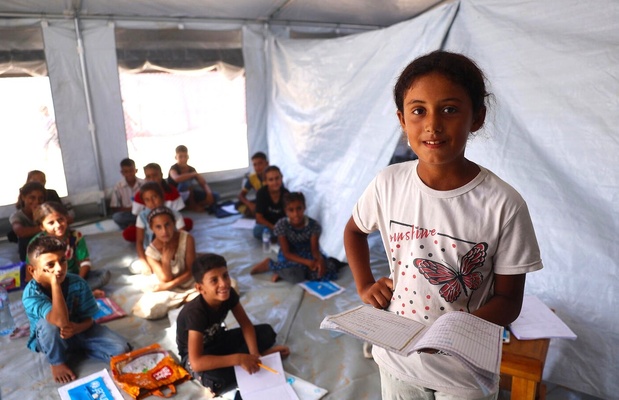
UNICEF is scaling up its education to support half of children of school age - around 336,000 - with learning support. Teaching will mainly happen in tents, Elder said, due to widespread devastation of school buildings in the enclave during the war which was triggered by Hamas’ assault on Israel on October 2023.
At least 97 per cent of schools sustained some level of damage, according to the most recent satellite assessment by the UN in July.
Israel has previously accused Hamas and other militant groups of systematically embedding in civilian areas and structures, including schools, and using civilians as human shields.
The bulk of the learning spaces supported by UNICEF will be in central and southern areas of the enclave, as it remains difficult to operate in the north, parts of which were badly destroyed in the final months of the conflict, Elder said.
UNICEF has already delivered one million thermal blankets, hundreds of thousands of winter clothing kits, opened more than 70 nutrition facilities across Gaza, and worked to get water and waste-water treatment plants back up and running.
UNICEF’s focus on education, it says, is equally important.
“In Gaza, learning is lifesaving. These centres provide safe spaces in a territory that is often inaccessible and dangerous,” Elder said.
“They deliver vital information. They restore routine. They connect children to health, nutrition and protection services.
“These UNICEF learning spaces also have proper toilets and places to wash hands - something too many children in shelters simply don’t have.”
The spokesman said that demand is overwhelming.
“Every existing learning centre has long waiting lists,” he said.
“Communities are creating their own makeshift classrooms in tents and damaged buildings. Parents are pleading for places. Children are showing up anyway.
“As the world talks about how Gaza will recover and rebuild, UNICEF is clear: children have to be at the heart of every plan.”
The Hamas-led attack in October 2023 killed 1200 people, according to Israeli tallies. Israel’s assault has killed 71,000 Palestinians, Gaza’s health authorities say. More than 20,000 children were reported killed, including 110 since the October 10 ceasefire last year, UNICEF said, citing official data.
(with AAP)