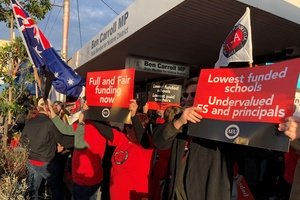


The new school funding agreements between the Commonwealth and the states have not set public schools are not on the path to full funding as government media releases say.
Despite a substantial and very welcome boost in funding, public schools will remain underfunded in 2034, 23 years after the Gonski Report recommended full funding.
Public schools will remain massively underfunded in each year until 2034. It is a shameful neglect of the challenges facing public schools and the learning needs of disadvantaged students, the large majority of whom attend public schools.
In 2034, public schools in all states and he Northern Territory (2029) will be funded at less than 100 per cent of their Schooling Resource Standard (SRS).
The estimated SRS funding shares are: NSW – 96.2 per cent; Queensland – 97.6 per cent; South Australia – 98.6 per cent; Western Australia – 97.8 per cent; Tasmania – 97.7 per cent; ACT – 106 per cent; Northern Territory – 95.8 per cent (2029).
The Victorian agreement is not published, and it is not clear whether an agreement has even been signed yet.
The underfunding is estimated $1.7 billion in 2034, and the loss is highly likely to be over $2 billion once Victoria finally signs up.
The underfunding estimates are: NSW – $888 million; Queensland – $425 million; South Australia – $120; Western Australia – $192 million; Tasmania– $37 million; Northern Territory – $53 million (2029).
Public schools will be heavily underfunded in each year until 2034. The cumulative underfunding is estimated at a massive $34.6 billion.
There are several reasons for the continuing underfunding.
First, the Commonwealth increase in its funding share for public schools from 20 to 25 per cent of their SRS is only gradually phased in and is heavily backloaded until the last five years in NSW, Queensland and South Australia.
By 2029, it will have increased by only 0.5 of a percentage point in Queensland, by 1.3 percentage point in NSW and by 1.25 points in South Australia.
Second, the 4 per cent allowance that allows the states to claim capital depreciation as part of their share of funding public schools will not be fully removed until 2034 and the reductions are mainly in the last five years.
But capital depreciation is specifically excluded from how the SRS is measured and its inclusion in state SRS shares defrauds public schools of their rightful funding.
In NSW, Western Australia, South Australia and Tasmania, this allowance will be reduced by only one percentage point to 3 per cent between 2024 and 2029.
In Queensland, it will remain at 4 per cent until 2028 and at 3.98 per cent in 2029.
Third, the states can still claim expenditures as part of their share of funding public schools that are specifically excluded from how the SRS is calculated. These allowances defraud public schools of their rightful funding.
They can continue to claim expenditure on regulatory authorities such as curriculum and standards bodies as it relates to public schools.
The Tasmanian and Northern Territory agreements even include expenditure claims for additional regulatory bodies not in the previous agreements.
The states can also claim a new separate allowance for expenditure on school transport for public school students.
NSW and Queensland can claim up to 1.8 per cent of the SRS. Western Australia and Tasmania can claim up to 1.5 per cent. South Australia can claim 1.07 per cent for school transport and 0.73 per cent for mid-year student intake.
The agreements admit these allowances are a “non-standard inclusion”. This is a remarkable admission by governments that these allowances defraud public schools of eligible SRS funding.
The continuing allowance to claim expenditure on regulatory authorities and the new allowances for school transport together account for the underfunding of public schools of $1.7 billion in 2034.
This funding loss from the non-SRS allowances is only slightly less than the $1.8 billion loss from them in 2024.
The new agreements unfairly discriminate against public schools by allowing governments to claim non-SRS expenditures as part of their share of funding public schools but not for their share of funding private schools.
Private schools are also subject to regulation and private school students are eligible for school transport subsidies in all states.
The state and Northern Territory agreements do not allow the governments to claim regulatory and school transport expenditure as it relates to private schools to be included as part of the share of funding these schools.
Discriminatory defrauding of public schools provides another resource advantage for private schools.
The agreements must be revised to give public schools better and fairer funding. The Commonwealth should accelerate the increase in its funding share of the SRS public schools to achieve 25 by per cent 2029.
State governments should remove the existing 4 per cent allowance for non-SRS expenditure by 2029 and immediately remove new non-SRS expenditure claims as part of public school funding.