
Having spent two years in the throes of implementing evidence-based instruction across the board at the regional Victorian school, Jackson says the finding is, in fact, entirely encouraging.
“It’s not that they don’t like coming to school, but they’re just being held to account,” he tells EducationHQ.
“They were pretty used to just having a free ride and coming in and just having a good old time, so all of a sudden … there’s a lot more expectation to do the right thing.”
Back in 2023, after some targeted in-house PD, school leadership were under the impression that really solid work was underway with explicit teaching, believing the instructional approach now formed the bedrock of teachers’ practice.
“But what we found, when we started to get into classrooms, was that things weren’t really changing – it wasn’t happening as well as what we’d hoped,” Jackson recalls.
Keen to move the dial, the principal joined AERO’s Implementation Project to guide his staff though the practical, often gritty process of instructional improvement.
It was an exciting moment to have such clear direction about where the school was heading, the leader says, and to be involved in research that would potentially inform policy and practice at the system level.
“It means we could all have a walk away, win-win situation.”
Working with former AERO instructional leader Steph Murphy, school leaders were encouraged to pin-point the barriers and enablers to a successful roll-out from the outset.
A driving fear emerged from staff on this front, Jackson says.
“One of the big barriers was around that notion of there wasn’t going to be autonomy. [Teachers] were worried that it was just going to be a heavily scripted process that probably may not have worked for our context.
“So initially, that was a huge barrier for the staff.”
Addressing these concerns and any lingering misconceptions straight up meant the majority of teachers were quick to buy into the project, he reports.
“It was a huge win for us. And [this new direction] wasn’t just coming from us either. It was coming from Steph and AERO and their readings.
“But it wasn’t ‘this is what you’re doing, and this is how you’re going to do it’.
“I think that was quite refreshing for the teachers and the team: it wasn’t going to be done to them, they were going to be working through it with us. So, we were all in the same boat.”
As the school waded through the implementation, many things that had been ‘nice to have’ but not essential to students’ learning were pruned away.
First on the chopping block were various inquiry units that had ‘been around for ever and a day’, Jackson reports.
“[It was a case of, ‘let’s do a half hour lesson on democracy’, rather than spend a four-week unit, as exciting as it could be, creating lesson plans all around that, and taking away from the real learning around English and maths, because our results really weren’t showing that we had that luxury,” the principal explains.
Next to go was play-based learning, along with inquiry-based learning more broadly.
The shift really hinged upon a cultural change within the school community to stick, Jackson says.
“There was a lot of refocusing around what it was to be a teacher at our school and what the expectations are for the students as well.
“So, it’s a scary thing, but we have to shift the culture from (being focused on) the adults in the school and make it all about the kids, which was an easy thing from my perspective.
“But for some people, it wasn’t. So, there was a lot of work that had to go into that…”
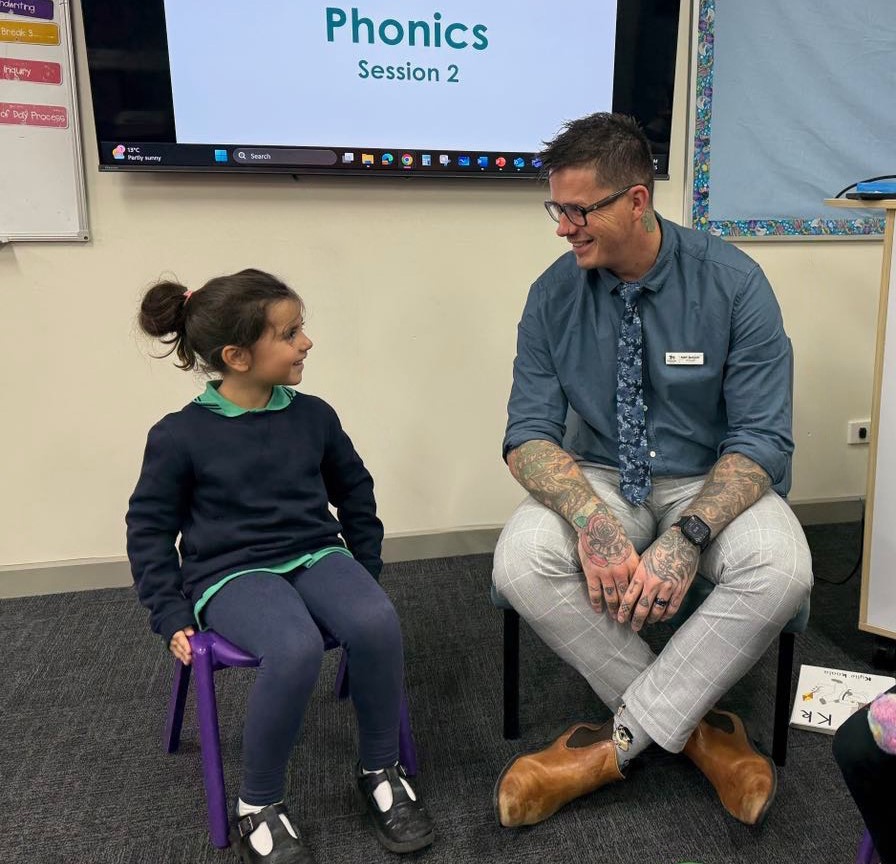
The principal (pictured above, right) says play-based and inquiry-based learning tasks were pruned away in the shift.
Throughout the at times testing journey, Jackson and deputy principal Lauren Jelleff returned to one premise time and time again.
“If it’s not good enough for our own children, it’s not good enough for anyone else’s.
“And that was our motto the whole way through in those difficult conversations.”
A new level of scrutiny also came into play, the principal adds.
“Everything came down to evidence. So, it might be nice to do this new program, but what’s the evidence behind it? What’s the research say? Is this going to be our best bang for buck when we implement it?
“We really had to shift the culture of ‘happy just to do things that I’ve done forever, because it’s comfortable and the kids really enjoy it’, but really the lessons weren’t teaching the kids what they needed to know.”
In this sense, a back-to-basics drive was sorely needed, the principal says.
“Let’s get the kids reading, writing, and adding and subtracting so that we can set them up for whatever successful career they have later on in life, not just ‘they had fun at school today’.”
AERO have recently released an Insights into Implementation 2025 discussion paper, which outlines the ‘most promising’ approaches for schools looking to implement evidence-based teaching in varied contexts.
Schools that take a deliberate and structured approach to implementation are reporting positive outcomes, the organisation says.
“Schools are increasingly drawing on evidence-based practices in their efforts to improve learning outcomes for all students,” AERO CEO Dr Jenny Donovan says.
“However, just knowing about evidence-based practices is not enough for schools to implement them effectively.
“How we go about implementation is just as important as what is being implemented.
“Aiming for sustainability – the point where effective evidence-based teaching becomes ‘the way we do things around here’ – is critical if improved student outcomes are the end goal.”
At Somerville Rise, Jackson says the positive impact of the initiative is showing up in all areas, from staffroom chats to the school’s NAPLAN results.
“It’s pretty good walking into the staff room and over-hearing conversations,” he says.
“When I first got here, it was all behaviour-related or things like that, whereas now it’s a lot more around learning improvements or having discussions about how we can do this or how we can do that to benefit students.
“And the community perception has changed significantly.”
Students now have a clear understanding about what success in their learning looks like, and can talk confidently to parents about where they’re at, Jackson reports.
“Academic, data-wise this year, our NAPLAN scores were amazing compared to where we’ve been.
“Our Year 5 writing reached above state average, which was pretty big for us. Writing has been a focus at our school for the last couple of years, and both our Year 3 and Year 5 NAPLAN data had strong results – we’re (sitting) in strong proficiency.”
Back to those student survey results...
Seeing a dip in satisfaction was only confirmation that the children are deep in the learning pit – exactly where they need to be, the principal says.
“They are in that wobble zone for a fair chunk of their time now.
“If you were to look at it [the data and see] there’s a drop, it’s really an understanding that it has dropped because [school is] not just cushy and fun anymore.”
“It’s OK that they’re not giving fluffy responses and high scores.
“They’re not enjoying aspects of the learning because it’s a real challenge for them at the moment, and that’s OK.”