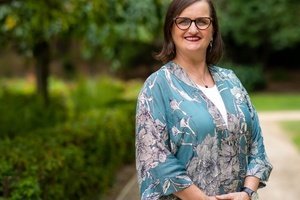


For Lara Harvey, head of PDHPE at Knox Grammar School in Sydney, getting PDHPE staff on board with teaching literacy has morphed into something of a personal mission – a ‘passion project’, she says.
After seeing the remarkable outcomes at her previous school Queenwood, Harvey is keen to share the huge benefits that come from embracing a school-wide writing framework, one where students are taught how to write well at a granular level and within different disciplines.
“So many of my colleagues were marking assessments or looking at students’ work and [saying], ‘Oh, the sentence structure is just not there, it doesn’t make any sense – I don’t know what the student is saying here’.
“But then when you ask the question, ‘well, what have you actually done about it?’ There isn’t that emphasis (on literacy instruction),” she tells EducationHQ.
Aware of broader NAPLAN data and the declining reading rates amongst teens, Harvey says she had a ‘lightbulb moment’ in class when the clear need to get serious about incorporating literacy struck.
“[Students] were exceptional in their verbal skills … but when it came to writing it down, a lot of them really struggled to express their ideas.
“And as a teacher, I really felt like I was doing my students a disservice to not actually explicitly teach them writing skills.
“[It hit me that for] these students, even from Year 7, they’re living in a world where there’s such a heavy emphasis on visuals; TikTok, social media – and they’re reading less than ever. Any research will tell you that students’ reading rates have gone significantly down.
“So, I was thinking about my own practice and how I really needed to hone in on teaching them explicit literacy skills,” she reflects.
Thanks to a well-timed professional learning experience led by AERO, over the course of a year Queenwood staff from four learning faculties worked to develop a literacy scope and sequence to embed in their lessons.
“The PD was amazing,” Harvey says.
“From 2024 onwards, we were delivering specific literacy focus in Year 7 and 8 within our PDHPE lesson content, and then that progressed into Year 9 in 2025.”
While daunting to be a novice in this space, the payoff was entirely worth the effort and the sense of discomfort that comes with mastering new knowledge and skills, the leader says.
“[Delivering effective literacy instruction] is not a skill that comes easily. I look at my teaching degree and I was never taught how to develop writing and literacy.
“And geography teachers, history teachers – they all want guidance and professional development on how to do this properly,” Harvey says.

Head of PDHPE Lara Harvey says more needs to be done at the system level to ensure all secondary schools can benefit from a school-wide approach to literacy and writing instruction.
So what might literacy look like in a PDHPE lesson? There’s certainly no need to reinvent the wheel here for starters, Harvey says.
“It does not have to be every lesson, just 10 minutes four or five times a term makes such a difference.
“Because you are relating content to your subject it does not feel like an English lesson at all, and AERO have content and resources that are linked to the PDHPE curriculum that you can use to ensure it is subject specific.”
Importantly, the focused literacy or writing tasks do not work as an add-on but rather form part of the learning underway.
“For example, when Year 8 students were studying culture in sport, we used an activity called Putting the Conjunction into Culture,” Harvey says.
“I explicitly modelled what simple and compound sentences look like, using PDHPE-specific content. Students then applied those structures to write their own sentences related to cultural influences in sport.
“This meant they were developing writing skills while deepening their understanding of the subject matter,” she notes.
It pays to remember that all teachers, regardless of their subject specialty, have to create as many opportunities as possible to prepare students for the Year 12 experience, Harvey says.
“And that’s sit an exam, a written exam.
“And once we get to the senior school level, usually by then, the (literacy) focus is lost as soon as the students get into Year 7.
“And why this is so essential is by the time they get to Year 11, we’re trying to fix a problem with their writing rather than perfect it.”
In terms of student outcomes, the feedback from teachers who have gone down this path is ‘overwhelmingly positive’, Harvey reports.
“In my previous school NAPLAN results went up in most areas significantly from a cross-faculty approach to explicitly teaching writing.
“Many students commented that learning explicit writing skills in subjects like PDHPE helped them understand that literacy is important in all learning areas, not just English.
“They also valued seeing different teachers approach writing in different ways.”
More needs to be done at scale to ensure all secondary schools can benefit from a school-wide approach to literacy, Harvey concludes.
“I feel from my exposure with this that there needs to be a lot more discussion.
“There needs to be a lot more PD on this area, because those teachers that have put it in place have seen significant differences.”