The Victorian educator says too often special education gets overlooked – both in research and as a rich source of professional development for all teachers.
“We don’t get spoken to a lot. We’re kind of hidden away sometimes,” Peverett tells EducationHQ.
“And being in this space and talking to mainstream teachers forever, we always feel a bit left out, because I think sometimes we don’t always get appreciated in terms of our knowledge.
“It’s like, we actually have a lot to offer.”
Peverett recently presented at a Sharing Best Practice event, where she set out to bust some myths that linger around teaching diverse learners.
Tellingly, only a few delegates opted to attend her session, she reports.
“Not many people came. And that’s because there’s a prevailing mindset that we only have to cater for the average or the high (ability students).
“Our students get left behind in the thinking about how to teach. A lot of really decent research has actually come out of this space, out of working with disability or working with learning difficulties … but this space kind of gets overlooked,” she says.
How well a school caters to its atypical students in the classroom ought to be the barometer of its performance as a whole, Peverett proposes.
“It’s controversial, but if we want inclusion to work as a society, that’s how we start it: we do the best by our students that need extra all the time, because that improves everybody else.”
Peverett believes initial teacher education should bring in mandatory placements at special schools as part of preservice teachers’ prac experience.
She says this would help aspiring educators to do away with labels and preconceived ideas about the needs and capabilities of atypical students.
“It will help with the understanding that one child with a disability is one child with a disability. We can’t box children just because they have a diagnosis. The diagnosis is not the child.
“I think one of the myths is that all children with disabilities present the same, and all children with a certain syndrome will present the same, but I’ve probably worked with more than 200 different people with disabilities and I can tell you that not one of them are the same, just like the general population.
“And unless you’ve got somebody in your family that has a disability, a lot of people don’t have that exposure to just understand that people are people – you don’t have to have a label."
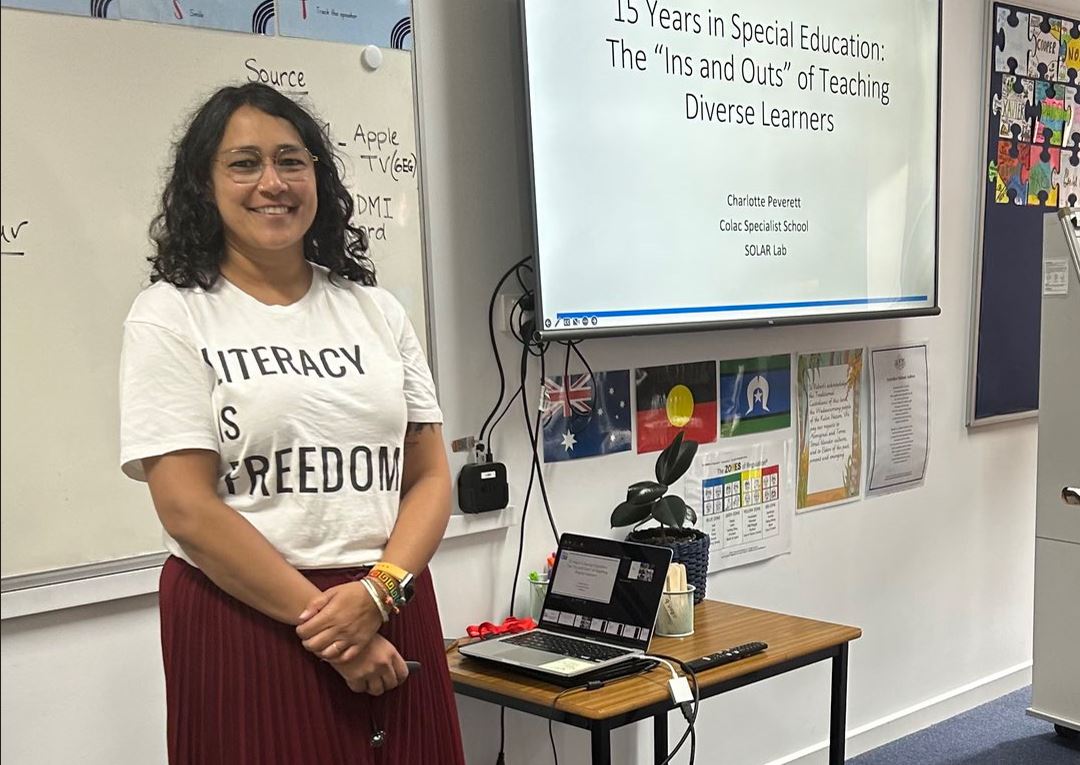
“We don't operate with labels, we just [look at] the child in front of us,” Peverett says.
You won’t find diagnostic labels circulating at Peverret’s own school.
“The labels sometimes are detrimental, because the labels can make people pre-judge,” she explains.
“In my school, I would not know what anyone has, because we don’t operate that way. We don’t operate with labels, we just [look at] the child in front of us and what we need to do for that child … I think that goes a long way [towards true] inclusion.”
Back in 2009 the educator began to wade into the science behind reading instruction. Eventually stumbling across the science of reading, she’s now contributing to the research base herself at La Trobe University’s SOLAR Lab.
One striking realisation so far is that we all learn the same way, and that special schools don’t need to have different programs or unique methods for students, Peverett says.
“There’s no real difference between how typical kids learn to atypical kids. It’s just that atypical kids need more time, more repetitions, more opportunities to practice and extra support to be able to [master it].
“So, there’s actually no reason to be using or looking at a different program to fill the gap. We’re pretty much using whatever other schools are using, we’re just putting a lot more … tiered instruction in place.
“So our Tier 1 is what Tier 2 would look like in a mainstream school.”
As the science of learning and the science of reading gains momentum in schools across the country, Peverret has one concern: the sheer pace of instruction it involves might not serve many atypical students.
“[It’s] moving into this really fast-paced, lots of content delivery (realm). For our students, some of them would become overwhelmed with that…
“I guess it’s that level of talk, that level of speed, and not enough repetitions.”
One enduring myth the educator would like to see gone is that students with an intellectual disability can’t learn learn to read.
“My research with the SOLAR Lab has shown ... it is only those students with complex and profound disabilities that may not learn to read. I think it is 0.1 per cent of the population from memory.
“It’s hard to call it out, but that is a massive myth … what we’re proving as a school is, they can, but (they) just need extra.”