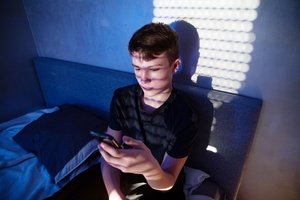


The comment comes following an update on the Government’s rapid review into school bullying, which warned policy was not keeping pace with the escalating AI deepfake and cyberbullying scene impacting students and teachers.
Earlier this year the Federal Government charged two experts with leading a review into school bullying. Dr Charlotte Keating, a clinical psychologist with a PhD in neuroscience, and Dr Jo Robinson, who leads the suicide prevention research unit at Orygen, have been tasked with developing a new national strategy that will be “grounded in evidence and informed by lived experiences”.
At a doorstop briefing yesterday, Education Minister Jason Clare told reporters the pair had so far received around 1700 submissions from parents, teachers and students.
“They’re criss-crossing the country at the moment talking to ministers, talking in some cases to mums and dads who’ve lost their children because of bullying, talking to everybody that wants to be heard here to make sure that we get this right,” Clare reported.
Keating indicated the issue of cyberbullying, deepfake attacks and ‘pornifying apps’ had emerged early on as pervasive problems schools are grappling with.
“I think when things work well it is generally when schools do feel equipped to tackle a problem and when they’ve got good policies in place and they feel able to implement those policies,” Keating said.
“I think one of the challenges with technology is it’s moving fast and it’s often moving faster than policies can keep up with…”
A cultural issue: expert
But ACU’s Dr Matthew White, a lecturer and researcher in inclusive education, says the rapid review risks skimming the surface of what is a deep-seated cultural problem that’s persisted for hundreds of years in our institutions.
From his own time working in the school system, White says it would be a mistake for the review to focus solely on identifying best-practice responses to bullying.
A more impactful move would be to explicitly teach students kindness, respect, and what it means to be a good person from the outset of their schooling, he argues.
“Drawing on my experience as a year coordinator, the time it takes to actually properly investigate and look at allegations of bullying, by the time students come forward and say they’re being bullied, it’s a complex matter of [sorting through] incidents that took place and often it’s too late,” he tells EducationHQ.
Bullying is really just the ‘tip of the iceberg’ when we consider broader dysfunctional behaviours and relationships, student disengagement and unsustainable staff workloads that we can see play out in schools, White says.
“I guess my worry when I see a rapid review, especially for really complex problems, is that whether it’ll get to the true heart of what the issues are and whether it’ll just gloss over and present the things that we tend to expect from a review,” he says.
A line comes to White’s mind when thinking about the problem of school bullying and the forms it now takes in the online world: ‘a culture in a school or an organisation is what happens when people aren’t watching’.
He says things like cyberbullying and AI misuse are symptomatic of deeper cultures within society.
“There’s issues with culture, as opposed to issues with people doing those things, and it comes back to looking at precipitating factors such as young people not being kind to each other in the first instances that lead to [these kinds of incidents].”
And while in the past, generally speaking, parents or the church might have taught children behaviours and values aligned with kindness and respect, we can no longer assume children arrive at school knowing how to behave well, White notes.
“It needs to be both explicitly and implicitly taught, so it needs to be part of the fabric of that school community...
“We presume that young people come to school knowing what ‘good’ is and knowing what respect is, but a lot of young people come from dysfunctional homes where they don’t get to see it.”
A game of catch up
A deepfake crisis response plan is something one SA school leader has said should be considered an essential part of all schools’ procedural toolkit.
The harm and reputational risk that artificial content poses to individuals and school communities is immense, White adds.
“The other aspect is the overexposure of young people to that sort of material as well,” he says.
”I think for me it’s like desensitisation to that that sort of material they see online, TikTok and YouTube videos and social media, where … they don’t have the maturity to be able to understand what they’re seeing a lot of the times.
”And … it also stems, definitely, from cultures where young people don’t appreciate being kind to each other or valuing each other.
“So by the time that those videos or [images] come out, it’s too late, the action really needs to be at that early stages of educating young people around appropriate behaviour online, being kind and respecting each other – not because you’re going to get into trouble or you’re going to be suspended, but because that’s the right thing to do.”
Clare noted cases over the last few months where students had used AI with malicious intent.
“…a student might crop a head of another student and put that on a naked body and use that to hurt and humiliate and harm other students and, in some cases, school teachers as well.
“This leaves scars that you can’t see and scars that sometimes never heal.
“The result is that sometimes teachers will leave the job that they love. And in the worst of all worlds, it sometimes means that students take their own lives, and we’ve seen evidence of that.”
When pushed on just how far behind policy was to safeguard schools against the evolving digital space, Keating indicated we are not completely off the pace.
“I don’t know that I would say that we’re terribly far behind. I think we’re working terribly hard to keep up, and I think some of the initiatives that the Government is developing are going to really help.
“But I think we do need to keep our foot on the pedal there,” she said.
Keating and Robinson’s findings will be presented to education ministers in October.
Clare said he was hopeful there would be unanimous agreement on the recommendations put forward.
“And then we’ll have to set out the plan for how we implement them…”