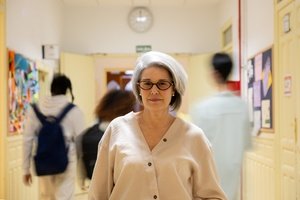

Dr Emma Hussey, a child safeguarding expert at Australian Catholic University’s Institute of Child Protection Studies, is now calling for young adult (YA) books to be subject to a classification system and come with clear content warnings.
The expert questions why these are applied to films and digital learning tools used in schools, but not books.
“I actually accessed a book with inappropriate content when I was a young 12-year-old,” Hussey says.
“My mum placed a call to our school library.
“Schools already rely on content ratings for films and digital learning tools. I guess the question here is, why not books?
“A classification system would give teachers and librarians a clearer guide for what’s developmentally appropriate – it would just be adding to the list of tools that they can use for curation.”
Hussey recently analysed 20 romance, fantasy, paranormal and general fiction novels pushed on ‘BookTok’ that are trending amongst children and teens – books that are sitting on school library shelves.
Her study found every novel contained elements of domestic violence, but A Court of Thorns and Roses, Lore Olympus and Once Upon a Broken Heart were specifically aligned with the Power and Control Wheel of domestic violence behaviours.
Themes across the 20 novels spanned assault, torture, grooming, dominance and submission, and sexual objectification. Misogynistic character portrayals were also evident, the research found.
Some 65 per cent of books featured graphic or extreme violence.
And in the largely unregulated TikTok space, the books shared by content creators are reaching an increasingly younger audience, Hussey indicates.
Educators should not be fooled by seemingly innocent front covers, she warns. They may well not reflect the content inside.
“Icebreaker and others such as Once Upon a Broken Heart [are] good examples here,” Hussey shares
“They are both cartoony covers, both very soft pastels – one of them has fairytale themes.
“Icebreaker has a skater figure leaning into a hockey male interest, and it actually kind of reminded me of the way in which Princess Diaries was marketed when I was young.
“So when [adults] see that sort of visual, that’s something to them that sparks the memory of what they used to read and what you would typically associate with younger audiences…”
Times appear to have changed here, Hussey suggests.
You only have to scour the pages of some YA books to realise they might be inappropriate at best and harmful at worst for young readers.
“There’s sexually explicit content throughout Icebreaker, and then in Once Upon a Broken Heart there are some mild, but still present, themes of domestic violence behaviours.”

Clear, industry-wide classifications and content warnings for distressing material in YA books are urgently needed, the expert says.
The message to educators is not one of censorship or restriction, the expert is quick to note.
“I think teachers and librarians are on the front line. You’re often the ones handing over the next book and that gives you a powerful role in shaping not just literacy but how students understand relationships and power.
“Fiction can be meaningful, engaging and empowering, but some of it contains complex adult themes that younger readers simply aren’t equipped to unpack without support.
“So, we’re not just talking about what kids can read, we’re talking about what they’re developmentally ready to process – and that’s a critical distinction.”
Rather than rushing to pull books off shelves, Hussey calls on educators to be overly mindful when recommending books to students.
“It’s about pausing to ask, ‘is this story right for this age group in this context with the support we can offer? We want to keep stories available, but we also want to protect the developmental safety of students.
“I don’t think that that’s restriction, I see that as responsibility.”
And while some books, authors and publishers do urge caution, including an 18+ warning that appears in small print on the back of the Icebreaker novels, more obvious industry-wide classifications and content warnings for distressing material are urgently needed, Hussey adds.
“…there needs to be more awareness. I think we need national support for educators and families, so we’re all working with the same tools, knowledge, and the same understanding of what is appropriate and when.”
Hussey says while she has a great deal of respect for school librarians and understands they carefully curate their collections, some key questions do need to be addressed.
“…we need to ask, are school librarians domestic violence informed, and are they aware of the ways that these sorts of behaviours can be subtly laid out on a page?”
If girls consistently consume stories where romantic love is tied to obsession, jealousy, possessiveness, or control, they may internalise these behaviours as normal or even desirable in relationships, Hussey warns.
“We are already facing a domestic violence epidemic. If girls grow up believing these themes are what they should be looking for in a relationship we run the risk of perpetuating this cycle.”