


She will be among the first Australians to receive a text message tomorrow morning containing her ATAR and study scores, marking the end of more than 13 years of schooling.
Victorian students will be the first to receive their scores, with the remaining states and territories to follow next week.
Zhou says she had worked hard to hopefully achieve an ATAR to study commerce at the University of Melbourne.
“I definitely think I did my best in VCE so I am expecting something good, but I am also trying to not raise my hopes,” she says.
“It is nerve-racking.”
But just how important is an ATAR score these days, and is its significance diminishing?
The answer is a firm ‘yes’ according to new research from Victoria University’s (VU) Mitchell Institute, which shows the ATAR plays a smaller and more uneven role in university admissions than many students and their families might think.
The report, Assessing the ATAR: Exploring the use of the Australian Tertiary Admission Rank (ATAR), suggests that while the ATAR may loom large in public debate, its real use in university admissions varies depending on where individuals live, the university they apply to, and the course they select.
For example, almost 100 per cent of school leaver admissions were made on the basis of ATAR at one university, yet only around 10 per cent at another.
ATAR-only admissions were most common in Engineering and Natural and Physical Sciences (72 per cent), while courses in Creative Arts, Education and Agriculture had the lowest proportion of admissions made solely on ATAR (41-43 per cent).
In 2023, half of all domestic undergraduate students starting a bachelor’s degree were not recent school leavers, meaning the ATAR was not relevant to their admission.
Even among those who were recent school leavers, three in 10 were admitted to university without ATAR being considered.
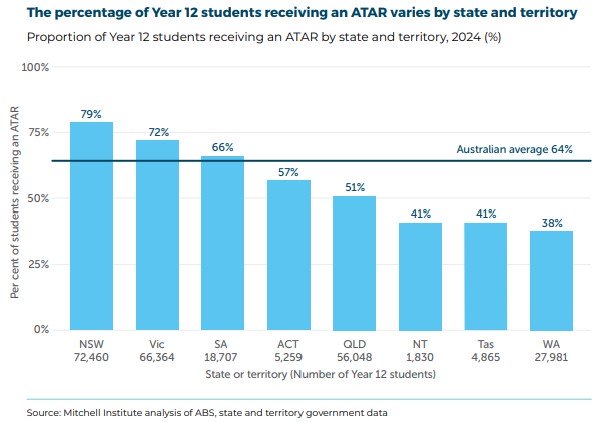
The research also found significant variation across the country when it comes to the ATAR.
In 2024, 64 per cent of Australian Year 12 students received an ATAR - including 79 per cent of NSW Year 12s, 38 per cent of Western Australian Year 12s - with take-up of ATAR declining in both WA and Victoria in recent years.
In an op-ed published by EducationHQ in November last year, Peter Hutton described the ATAR as an outdated system that promises to “define students’ future,” but asked at what cost.
Hutton is the Executive Director at Global Village Learning, a highly progressive school in the Macedon Ranges in Victoria.
“For two years, teachers focus solely on exam preparation, students sacrifice sleep for late-night cramming, and a booming market of professional tutors caters to families who can afford them,” he wrote.
“This singular focus has now filtered down with elements replicated even within the upper primary years. This cycle breeds anxiety, stress, and a misconception that exam success will shape one’s entire life.”
Hutton said the ATAR is not designed for the success of the majority; its primary function is to rank students, creating winners and losers in an unfair system.
Despite being in use for over 15 years here, we remain an outlier internationally as the only jurisdiction among 251 countries and territories that uses percentile rankings to compare students directly.
His question is: when only 40 per cent of students move directly into university, and only 60 per cent of that 40 per cent rely exclusively on their ATAR, why must all Year 12 students participate in a “game” to generate a ranking used by less than one in four of them?
While Zhou’s ATAR score is an important means of accessing her chosen course and university, one gets the impression she has an bright future in front of her, regardless.

The ATAR has been used in Australia for more than 16 years now, yet we remain an outlier internationally as the only jurisdiction among 251 countries and territories that uses percentile rankings to compare students directly.
The resourceful high school graduate has already launched her career, having created a money-saving initiative for young people, published a book, hosted a podcast, and been recognised as a rising star at the Asian-Australian Leadership Awards.
Despite her success, she still feels nervous about the impending results.
“It can definitely feel very intimidating,” Zhou says.
“It’s important to try to zoom out on the grand scheme of things and tell myself I will get the score I deserve because I’ve tried my best.”
For some, the arrival of a desired ATAR score will crystallise career pathways.
For others, it could be disappointment, and a rethink on plans.
Mitchell Institute Director Professor Peter Hurley says the findings from his research highlight the need for clearer information for young people and their families navigating Year 12.
“The ATAR is often treated as if it decides everything, but our analysis shows it applies much less often than people think,” he says.
“Three in ten school-leaver admissions were made on a basis other than ATAR.
“Students deserve clear information about what the ATAR means, how it will be used, and about the full range of pathways available to them,” Hurley says.
La Trobe University professor Therese Keane acknowledged the current system can bring dispiriting news to some students.
“It’s human nature to be nervous even if you think you are going to do really well,” she says.
Keane says students should take the time to interpret their results, reconsider their goals and make use of the support services available to them.
“Some students might be feeling quite disappointed with their scores,” she says.
“There are so many different pathways now, so whatever you get won’t be the defining moment that stops you from pursing your dreams.”
Students in SA and the NT will receive their ATAR results on December 15, followed by Tasmania on December 17, NSW and the ACT on December 18, and finally WA on December 19.
Click here for a summary of the research paper: ‘Assessing the ATAR: Exploring the use of the Australian Tertiary Admission Rank (ATAR)’.