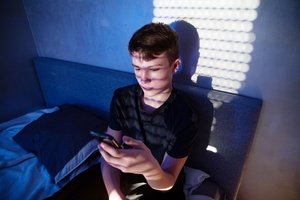


Produced by Edith Cowan University (ECU), and thanks to a $240,000 Australian Research Council (ARC) Linkage Grant, the research team will work with teens to co-design strategies that support their sexual wellbeing and recognise them as experts in their own experiences.
By drawing on teens’ insights, they aim to build young people’s skills to critically evaluate online pornography and its associated risks, informing future relationships and sexuality education.
Almost one-third of Australian children have seen sexually explicit images or videos like pornography online, according to new eSafety research.
A nationally representative survey from early 2025 of 3454 children aged 10 to 17 years-old found 32 per cent of kids have been exposed to sexual images or videos online.
“Given teens encounter online pornography long before turning 18, there are calls for pornography education, (also known as porn literacy), however, from our research it was clear that teens are already critical thinkers, able to discern fantasy from reality,” ECU researcher and sexologist Dr Giselle Woodley says.
“We want to design strategies alongside teens that respond to their existing wisdom and that they will be responsive to.”
Woodley explains that ignoring the topic only increases the risks.
“While we are moving towards age verification, social media bans and restrictions, we need to consider bolstering education, too,” she says.
“Teens in our previous research have told us education is the most effective strategy forward.
“This research is about helping young people unpack what they’re seeing, ask questions, and develop the tools to make sense of it safely.”

Dr Woodley says that ignoring the subject of teen exposure to porn online only increases the risks. “While we are moving towards age verification, social media bans and restrictions, we need to consider bolstering education, too,” she says.
The study will adopt a multi-level approach where strategies devised by teens will be road tested for feasibility and responded to by parents and educators.
“Teens feel awkward discussing these topics with the adults in their life, and often detect their judgement or discomfort too,” Woodley says.
“Similarly, even in the face of these bans, which teens have also told us they can overcome, if adults assume teens aren’t seeing porn, we leave them vulnerable to misinformation and potentially harmful ideas about sex, consent and relationships.”
The research team will work with teens to co-design strategies that support their sexual wellbeing and recognise them as experts in their own experiences.
Building on years of research
This new project builds on years of ECU research exploring teens’ experiences with online sexual content.
Earlier findings were recently cited in a New South Wales parliamentary inquiry, which adopted many of the researchers’ recommendations calling for youth-informed pornography education and better support for families and schools.
Woodley says this new phase of research takes that evidence from policy to practice.
“We’re putting teenagers in the driver’s seat,” she says.
“They will help shape what porn literacy should look like, how it’s delivered, and how adults can support them in a way that feels real, relevant, and that they will be receptive to.”
The project will involve nine teen-based workshops and 40 individual interviews, as well as sessions with teachers and parents to trial teen-led strategies to open up intergenerational conversations.
eSafety Commissioner Julie Inman Grant says pornography is so pervasive and invasive that children are often stumbling across it by accident. In response, eSafety is providing advice advice on how to protect children from seeing too much, too soon.

eSafety Commissioner Julie Inman Grant wants children to understand the pillars of a healthy relationship begin with consent and respect. Pornography, she says, can be the antithesis of that – and kids’ exposure to violent and extreme pornography is a major concern.
She recently registered new codes, drafted and submitted by industry, which require a wide range of technology services to do more to restrict children’s access to porn, high-impact violent material, and material that encourages self-harm, suicide or disordered eating, and to empower users of all ages to control the material they do not want to see.
These codes cover search engine services, hosting services, internet carriage services such as telcos, app stores, device manufacturers, social media, gaming and messaging services and other apps and websites, including some generative AI services.
“We know kids are naturally curious and they may either stumble upon or search out sexualised material as they enter adolescence and explore their sexuality, which is why it is critical tech companies, up and down the stack, have greater protections in place,” Inman Grant says.
“Our holistic and layered safety approach places the onus on tech companies to provide vital and robust protections for all Australians, especially children.”
Woodley, Professor Lelia Green and Dr Christopher Kueh will work with industry partners The Daniel Morcombe Foundation and Sexual Health Victoria, and international porn literacy expert Dr Siobhan Healy-Cullen from Massey University NZ to explore these issues in workshops across the country.
Research outcomes will be shared through partner organisations, policy submissions and education networks across Australia, helping families, schools and communities engage more confidently.