
“We're trying to do it consistently every single week in our school, and I think of particularly one of our Koorie students who just walks in here every day, and this is his school now, and that is such a buzz for me.”
These are the words of Milawa Primary School lead teacher and wellbeing leader, Ash Campbell, who tells EducationHQ it’s pretty much NAIDOC Week every week now, such is the school community’s commitment to embedding First Nations culture, perspectives, and practices into the very fabric of the school’s educational environment.
Over the past three years, Milawa Primary, in the state’s north-east, has undertaken a transformative journey to deeply embed First Nations perspectives into its teaching and learning approaches.
“I know there are significant dates on the calendar (like National Sorry Day, Mabo Day, NAIDOC Week, National Reconciliation Week etc), but in our story here, we live and breathe it on a daily basis with a lot of the work we do.
“We quite often talk to the kids about different days that pop up of significance, but to embed them in what we do, we need to be reminded of these things each day and week through some of the work that we’re doing.”
Campbell and Milawa principal Bron Knight have worked tirelessly to build what they call a ‘culturally safe school’.
Their wonderful work saw the school honoured in late May in the Education Department’s Marrung Awards, for ‘Excellence in Teaching, Learning and Development’, which recognises educators who’s dedication, expertise and efforts have assisted Koorie children to optimise their health and wellbeing.
Established in 2021, the Awards celebrate the unique knowledge and skills that Koorie staff and allies bring to the department, to create better educational outcomes for Koorie students.
It’s been quite a journey
Milawa Primary is a small rural school of 67 students, including five Indigenous kids, spread across four classes. It’s a heavy generational farming community, going back five generations.
Just 15 minutes drive from the large rural city of Wangaratta, and its relative level of cultural diversity, besides a smattering of Italian immigrants that moved to the area during the post-war period, Milawa’s worldliness until recent times has been relatively limited.
While Wangaratta and the region had done a great deal of work in the last decade in terms of acknowledging its Indigenous history, as a school, Milawa Primary was dragging its heels and so it was decided three years ago that the school needed to follow suit.

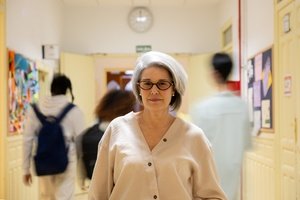
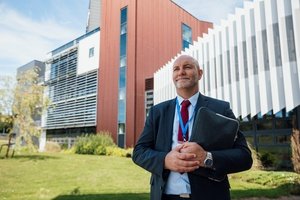
Milawa Primary School principal Bron Knight, above middle, and Lead Teacher Ash Campbell, above right, receive their Marrung Award on May 28.
Much of that was facilitated via the Marrung Education Plan, (2016-2026) a statewide strategy developed to ensure that all Koorie Victorians achieve their learning aspirations.
Marrung’s governance is dependent on Koorie communities and stakeholders coming together at local, regional and statewide forums, to discuss education and training needs, issues and priorities for their communities, and feed into DET’s education planning and delivery processes.
“I’d been a principal for 21 years, and in 2023 went back to the coalface and had a Grade 2-3 class,” Campbell shares.
“It was my first year full-time back teaching for a very long time, and I had a mate that I worked with up in Mildura, a specialist career education school, and he was passing through.”
Campbell asked if he’d come in and spend some time with his students, which he happily agreed to.
“He did some dance with them, and they had some really deep-level questions for him about his Koorie heritage, about Reconciliation Week, and Sorry Day – which he answered.”
Sadly, there was substantial backlash from “a very small minority” of the community, who were at the time concerned that there’d been discussion about these issues in the school.
Far from deterred, and seeing the immense potential at the school, Knight doubled down and offered Campbell the leadership role in the Marrung space. Through his local Marrung network and the department the educator then began building deeper knowledge.
“Bron helped me create a weekly 90-minute specialist subject (for all students from Prep to Grade 6) which we call ‘ACE’ – Australian Culture and Environment,” Campbell says.
While heavily based on the humanities – geography, history, science, environmental science, and so on – all of the learning in the subject is under an Indigenous umbrella.
“I was provided with some deep-level professional development and did five days SPIKKE (Strengthening Principal’s Professional Capability in Koorie Education) training last year,” he says.
SPPIKE equips school leaders to have challenging conversations, actively engage the school community and promote positive cultural identity and excellence in schools.
“It was the most powerful training I’ve ever done in my 29 years in education, and we’ve just really continued to build on it,” Campbell says.
“As a school, we’re starting to embrace that across all of our teaching as well – and hence, two-and-a-half years later, we’re standing on a stage in Melbourne receiving an award for it. We’re pretty proud of that,” he adds.
The school’s staggering transformation
Importantly, the school has engaged with their local Koorie Engagement Support Officer (KESO) to guide initiatives and provide support for Koorie students through Student Support Groups (SSGs).
“If you walk into even our library now, we’ve got a whole designated area of mentor text – based on Indigenous stories,” Campbell says.
“They range from autobiographies through to storytelling stories – I used Isaiah Firebrace’s book Come Together last year as my mentor text for ACE, it’s beautifully written.”
A collaboration with the MACC (Mobile Art Craft Centre) art teacher has resulted in the creation of a playground mural that includes native animals and flora that are endemic to the area and reflects Koorie cultural connections.
“We’ve done excursions to the Winton Wetlands and to the Indigenous cultural centre there and spent time on country,” Campbell shares.
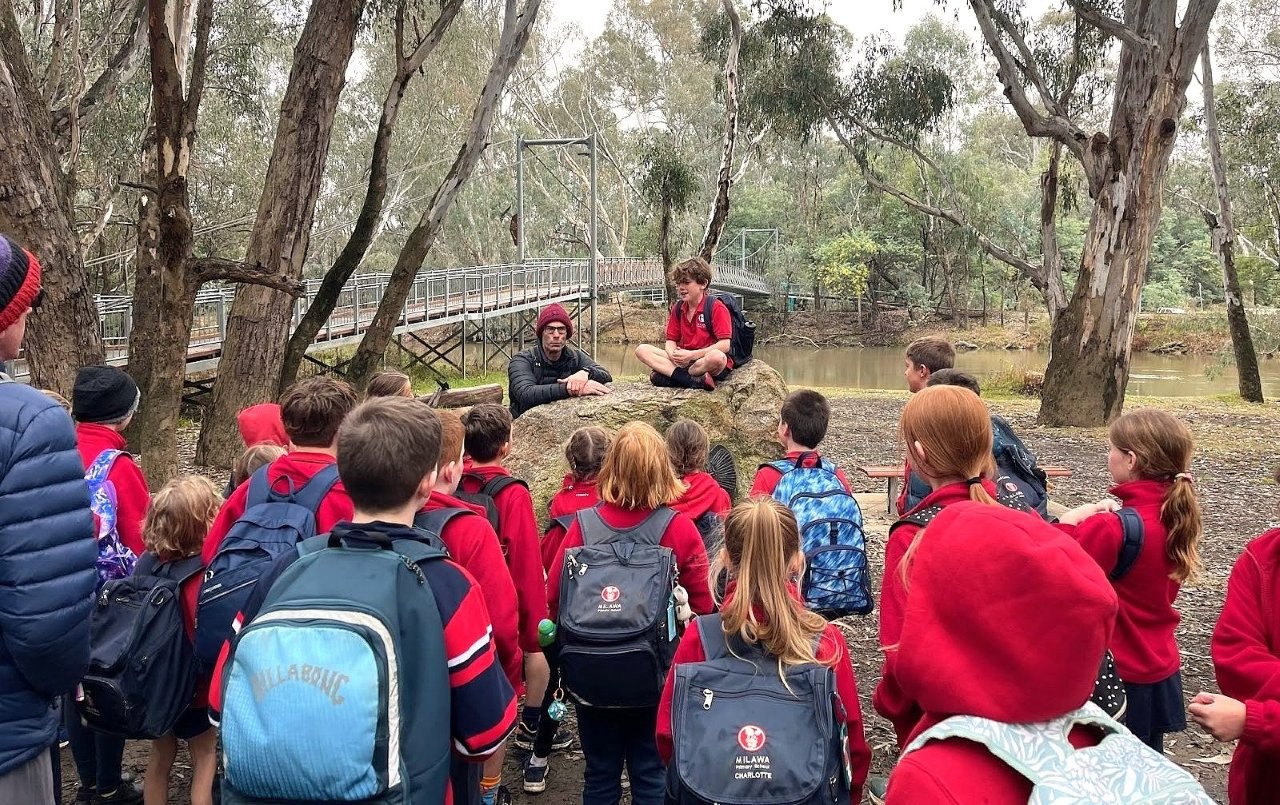
“There’s a beautiful trail also in Wangarata called the Bulawa Trail, which we took the whole school to. We walked along there and the kids who’d researched local stories were sitting on rocks and telling all the other kids what they’d learned about those stories.”
Campbell says the overriding aim that he, Knight and the entire team at Milawa have worked towards, is to forge a culturally safe school.
“That’s the biggest ticket item I can see that we’ve done here,” he says.
“That anyone who walks into our school, regardless of what culture you come from, we are a safe place for you to come to. And the Indigenous side of it has taught us so much about how to make our school culturally safe.”
Campbell says the response by students and the broader school community to their efforts has been soul-stirring.

Campbell says the school has been mindful of not overselling aspects like acknowledgement of Country with tokenism, and have tried at all times to respect the community’s context.
“From the kids’ perspective, the most beautiful time I have with ACE, which I teach every Wednesday right across the whole school, is we do an acknowledgement yarn circle at the start – but the kids are the ones who acknowledge country and the way that they’re now deeply connecting with what that actually means is incredible.
“And I think what I encountered in 2023 to where we are now, it’s the kids who have been the drivers of the education for their parents.”
They’ve become really curious about the bigger issues, Campbell explains.
“But we’ve also done it contextually with our community in terms of being proactive but gently introducing things. And I can just see there has been a huge dynamic shift with the community and they’re very proud of the work we’ve done.”
Far from soapboxing and tokenism with what they do – it’s really been about consistency.
“We just have embedded it in our practice in what we do right across the whole school.
“I’m taking staff through some pretty deep-level professional development in this space, and again, I’m doing it gently because, as we all know, there’s so much for teachers to take on these days in their classroom practice.”
The importance of allies
As a non-Indigenous man working in this space, Campbell acknowledges he has a great deal still to learn – and that’s despite a deep background and involvement in Koorie education over 30 years, since he graduated university.
“I’m very, very respectful and very careful still in this space, in that I stay in my lane,” he says.
The long-time educator says non-Indigenous teachers fear they’re maybe going to “do it wrong”, or make a mistake or they’re going to offend someone.
“From my perspective, because I’ve had this reach opportunity right throughout my career, I seem, as a white man, to be able to empathise and get what needs to be done in schools – but there’s so many teachers out there that are still so fearful of it.
“SPIKKE taught me not to be fearful, to actually be brave and go out there and learn – and then just practice some of this stuff and make connections with your local people, make connections right throughout education of people that can assist you.
“And the proof is in the pudding that we’ve got 67 kids who have got a really deeper level understanding of our 65,000-year old culture that’s formed this country, which is great.”
Campbell describes his principal as “a visionary”, who has been incredibly supportive in terms of what she wanted as a vision for the school, but also very good at distributing that leadership as well.
“She has full trust in me in my Marrung league to lead this work – and you do work beside each other in this work,” he says.
“She’s very invested in it as well, which has been terrific.”
So while schools are this week acknowledging NAIDOC Week, and celebrating Indigenous voices, culture, and resilience, Milawa will be too, only perhaps without it being anything much out of the ordinary.